

Coating Service Overview
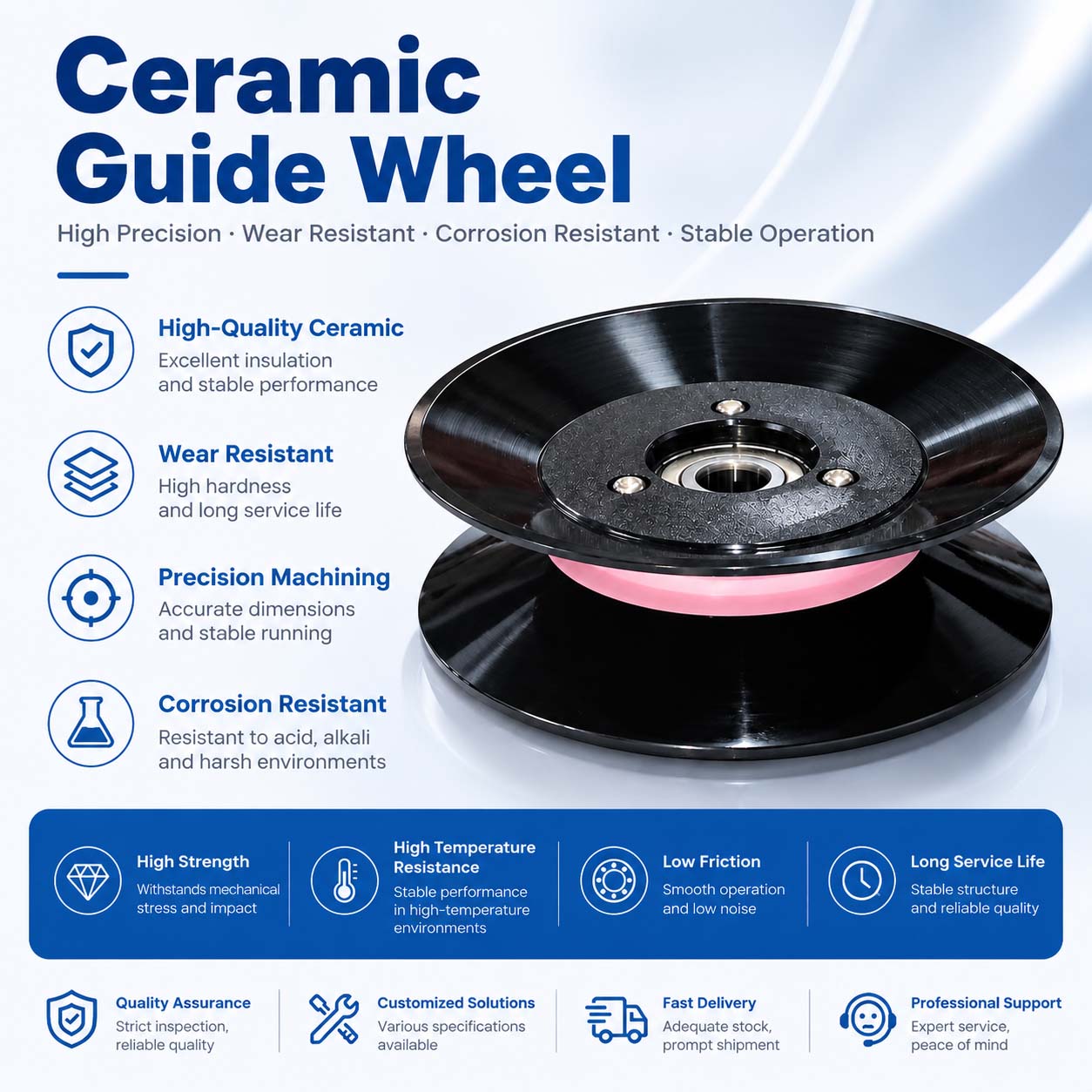
In high-speed wire production and processing, guide wheels and wire guide rollers are critical contact components that directly affect wire surface quality and equipment stability. The CR1010 Zirconia Ceramic Wire Guide Wheel features a lightweight design of approximately 120 g and combines the high hardness, low friction, and excellent chemical stability of ceramic materials to provide a reliable guiding solution for various wire applications.
This article introduces the material characteristics, typical applications, selection considerations, and maintenance recommendations of CR1010.
Material and Features
The CR1010 series is mainly manufactured from zirconia ceramic (ZrO₂) or alumina ceramic (Al₂O₃).
Zirconia Ceramic
Zirconia ceramic offers:
- High fracture toughness
- Excellent impact resistance
- Good wear resistance
- Stable performance under demanding conditions
It is suitable for applications requiring both durability and resistance to mechanical stress.
Alumina Ceramic
Alumina ceramic provides:
- Higher hardness
- Excellent abrasion resistance
- Good chemical stability
- Reliable performance in wear-intensive environments
Both ceramic materials share the following advantages:
- Smooth surface: Low friction reduces wire scratching and surface damage.
- Excellent wear resistance: Extends service life under continuous operation.
- Chemical resistance: Suitable for humid, corrosive, and chemical environments.
- Electrical insulation: Non-magnetic and suitable for special applications requiring insulation.
With a lightweight structure of approximately 120 g, CR1010 is easy to install and suitable for high-speed operation where dynamic balance is important.
Typical Applications
CR1010 zirconia ceramic wire guide wheels are widely used in:
Wire and Cable Manufacturing
Used in wire drawing, stranding, cabling, and other processes to guide copper wire, aluminum wire, alloy wire, and other conductors while reducing surface wear.
Textile Machinery
Applied in synthetic fiber spinning and yarn winding processes to provide smooth guiding and reduce fiber damage or hairiness.
Spring and Steel Wire Processing
Used in spring machines, wire straightening equipment, and other high-speed wire processing systems where wear resistance is required.
Precision Wire Processing
Suitable for optical fiber, welding wire, guitar strings, and other fine-diameter materials requiring accurate and smooth guidance.
The correct groove design and wheel size should be selected according to wire material, diameter, speed, and tension conditions.
Selection and Installation
How to Select the Right Guide Wheel
Wire Diameter Matching
The groove radius should be slightly larger than the wire radius to avoid excessive pressure, jamming, or accelerated wear.
Material Selection
- Choose zirconia ceramic when higher toughness and impact resistance are required.
- Choose alumina ceramic when maximum hardness and wear resistance are the priority.
Structure Design
Depending on equipment requirements, guide wheels can be supplied as integrated or modular designs. Modular structures make replacement and maintenance easier.
Installation Recommendations
- Ensure the wheel shaft is perpendicular to the wire running direction to prevent uneven wear.
- Install ceramic components carefully using proper tools. Avoid impact or hammering.
- Check that the wheel rotates smoothly after installation.
- Inspect bearings and alignment if abnormal resistance or vibration occurs.
Maintenance Recommendations
Proper maintenance can significantly extend the service life of ceramic guide wheels.
- Regular Cleaning: Remove dust, wire residue, and contaminants from the wheel surface and groove using a soft cloth or compressed air.
- Wear Inspection: Replace the wheel when deep grooves, abnormal wear, or wire surface damage appears.
- Bearing Maintenance: Lubricate bearings according to equipment requirements to prevent bearing failure that may damage the ceramic component.
- Proper Storage: Avoid stacking, impact, or dropping ceramic parts. Although ceramic materials are extremely hard, they are relatively brittle.
Frequently Asked Questions
Can CR1010 guide wheels be used in wet environments?
Yes. Zirconia and alumina ceramics have excellent water resistance and chemical stability, making them suitable for environments involving water-based lubricants or cooling fluids.
Is the 120 g weight fixed?
120 g is a typical specification. Actual weight may vary depending on wheel diameter, groove design, thickness, and customization requirements.
How do I know when the guide wheel needs replacement?
Replacement is recommended when the groove develops noticeable wear marks, the wire surface shows scratches, or the wheel rotation becomes unstable.
Can zirconia and alumina guide wheels replace each other?
If the mounting dimensions are identical, they may be interchangeable. However, the material should be selected according to working conditions: zirconia provides better toughness, while alumina offers higher hardness.
Can groove profiles and dimensions be customized?
Yes. Custom groove designs, dimensions, and mounting structures can be manufactured according to customer drawings, samples, and equipment requirements.
Will ceramic guide wheels rust?
No. Ceramic materials are inorganic, non-metallic materials and do not rust. They also provide excellent resistance to acids, alkalis, and corrosion.
Customized Ceramic Guide Wheel Solutions
We provide customized zirconia ceramic guide wheels and wire guide rollers for wire, cable, fiber, textile, and precision manufacturing industries.
Wheel dimensions, groove profiles, ceramic materials, bearing configurations, and surface finishes can be customized to meet specific production requirements, providing high precision, stable operation, and long service life.
