

Coating Service Overview
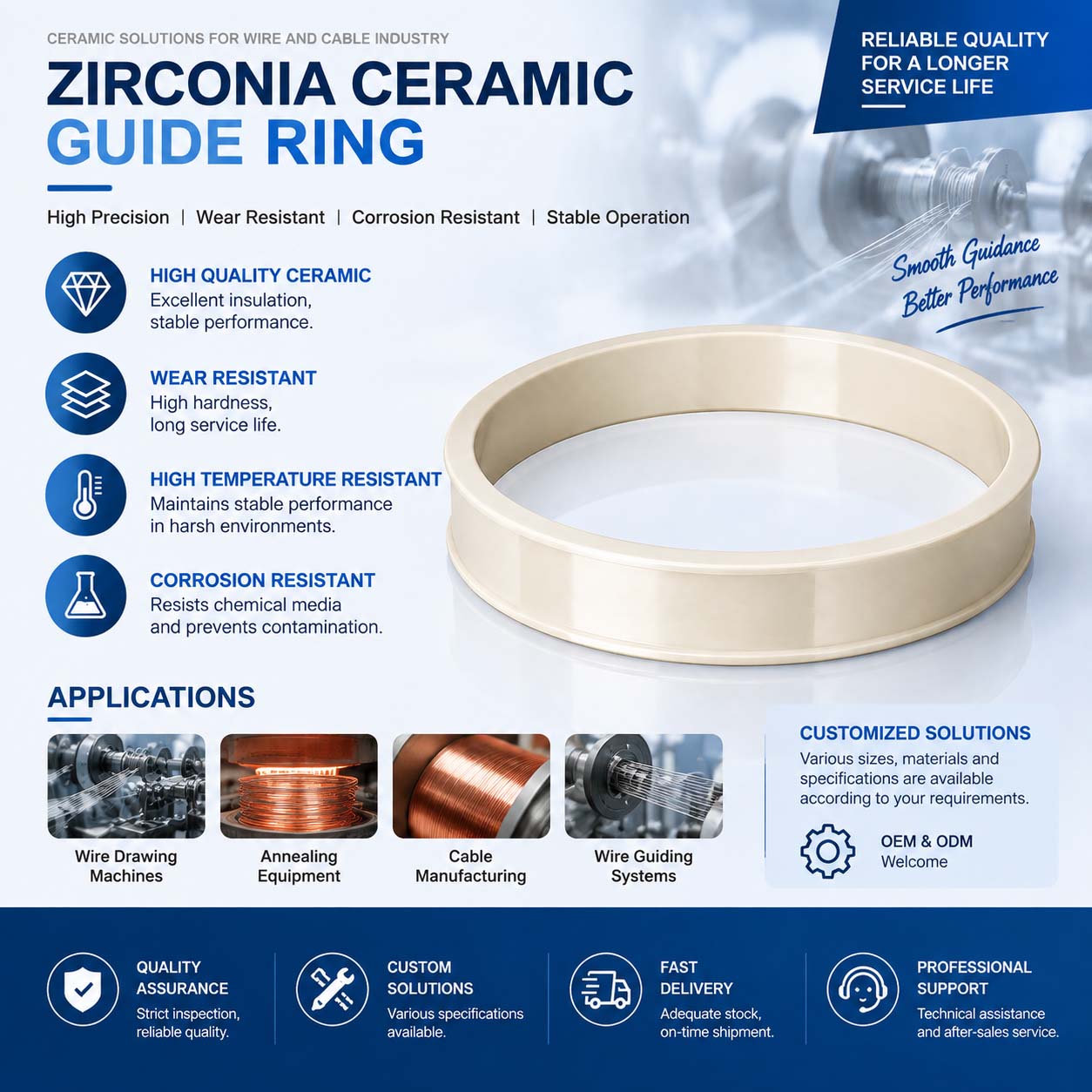
In the wire and cable manufacturing industry, the annealing process plays an important role in improving wire performance and product quality.
As a key component in annealing equipment, the zirconia large drawing ring guides wire smoothly through high-temperature areas. Made from high-purity zirconia ceramic, it provides excellent wear resistance, low friction, and outstanding thermal shock resistance, making it an ideal component for high-speed continuous production lines.
This article introduces the applications, selection considerations, and maintenance methods of zirconia large drawing rings to help users maximize performance and service life.
Material Features of Zirconia Large Drawing Rings
The performance advantages of zirconia drawing rings come from advanced zirconia ceramic material (ZrO₂).
High Wear Resistance
Zirconia ceramic has excellent hardness and wear resistance.
Advantages include:
- Smooth surface performance
- Reduced wire scratches
- Long service life under continuous contact with metal wires
Low Friction Coefficient
The smooth ceramic surface reduces:
- Wire running resistance
- Energy consumption
- Wire vibration
which helps maintain stable production.
Excellent Thermal Shock Resistance
During frequent heating and cooling cycles in annealing equipment, zirconia ceramic can withstand temperature changes and reduce the risk of cracking caused by thermal stress.
Chemical Stability
Zirconia is chemically stable and does not easily react with:
- Metal wires
- Processing atmospheres
- Industrial lubricants
This helps prevent contamination of wire surfaces.
Applications and Selection Guide
Typical Applications
Zirconia large drawing rings are mainly installed in wire guiding systems of annealing equipment, including:
- Continuous annealing machines
- Wire drawing and annealing integrated lines
- Preheating systems before cable insulation extrusion
Their main function is to provide low-friction support while maintaining:
- Stable wire tension
- Smooth wire movement
- Reduced risk of wire breakage and surface defects
Selection Considerations
When selecting zirconia large drawing rings, consider:
Wire Diameter and Material
Different wire sizes require suitable:
- Groove dimensions
- Ring specifications
- Contact designs
Common applications include:
- Copper wire
- Aluminum wire
- Alloy wire
- Copper-clad aluminum wire
Working Temperature
Zirconia ceramic can withstand temperatures above:
1000°C
However, actual operating temperature should be evaluated according to equipment conditions.
Installation Dimensions
Confirm:
- Inner diameter
- Outer diameter
- Thickness
- Shaft or bearing matching dimensions
to ensure proper installation.
Surface Finish
Higher surface smoothness reduces friction.
Recommended surface roughness:
Ra ≤ 0.4 μm
for precision wire processing applications.
Customized groove designs and non-standard sizes are available according to drawings or samples.
Installation and Maintenance Recommendations
Proper installation and maintenance can significantly extend service life.
Installation Inspection
Before installation:
- Check for cracks or chips.
- Clean the surface and remove oil contamination.
- Handle carefully to avoid impact damage.
Alignment Adjustment
After installation:
- Check radial runout.
- Ensure proper alignment.
Recommended runout control:
≤0.02 mm
to prevent uneven wear.
Regular Cleaning
During operation, metal particles and oxides may accumulate in the groove.
Recommended:
- Clean regularly with soft cloth or copper brush.
- Avoid hard tools that may damage the ceramic surface.
Wear Inspection
Regularly check groove wear.
Replacement is recommended when:
- Groove wear exceeds 0.1 mm
- Visible grooves appear
- Wire surface quality decreases
Storage
Keep spare rings in:
- Dry environments
- Dust-free areas
Avoid collision with hard objects.
Frequently Asked Questions
1. What wires are suitable for zirconia large drawing rings?
They are suitable for:
- Copper wire
- Aluminum wire
- Copper-clad aluminum wire
- Alloy wire
The groove design should be selected according to wire hardness and diameter.
2. How to know when the drawing ring needs replacement?
Replacement is recommended when:
- Groove wear becomes visible
- Wire scratches appear
- Wire breakage increases
- Surface accuracy decreases
3. Can zirconia drawing rings be repaired?
Generally, zirconia ceramic rings are not recommended for repair because ceramic materials cannot easily recover original precision after severe wear.
Replacement is usually the preferred solution.
4. What should be considered during installation?
Important points:
- Keep mounting surfaces clean.
- Avoid direct impact.
- Use proper installation tools.
- Ensure accurate alignment.
5. What are the advantages compared with metal guide rings?
Zirconia ceramic rings provide:
- Higher wear resistance
- Better temperature resistance
- Lower friction
- No metal powder contamination
making them suitable for precision wire processing.
6. Can non-standard sizes be customized?
Yes.
Customized options include:
- Inner diameter
- Outer diameter
- Groove type
- Thickness
- Special dimensions
Production can be based on customer drawings or samples.
