

Coating Service Overview
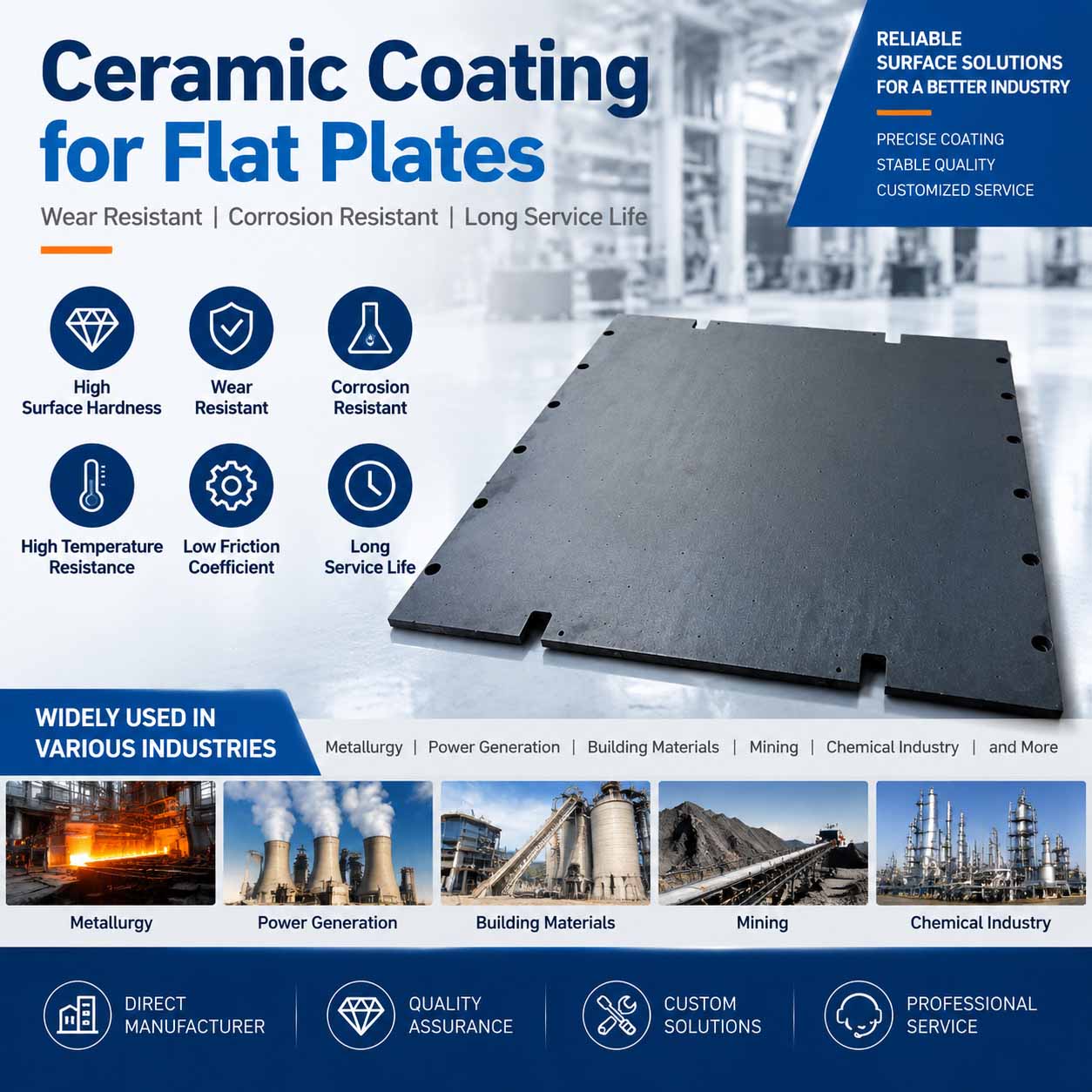
In industrial manufacturing, many components operate under high temperature, corrosion, and severe wear conditions, where traditional materials often cannot meet service life and reliability requirements.
Ceramic coating and surface treatment solutions are developed to improve the performance of these demanding components. Through advanced processes such as thermal spraying and ceramic coating, a dense functional layer is formed on metal substrates, providing excellent resistance to heat, corrosion, and wear.
These surface treatments help extend equipment life, reduce maintenance frequency, and lower overall operating costs.
Applications and Typical Components
Our surface treatment technologies are widely used for industrial wear-resistant parts, corrosion-resistant components, and high-temperature applications, especially in wire, cable, and metal processing equipment.
Flat Plate Components
Examples include:
- Machine panels
- Guide plates
- Sealing surfaces
Ceramic coating provides:
- High surface hardness
- Smooth finish
- Reduced friction
- Improved anti-adhesion performance
Shaft and Roller Components
Common applications:
- Electromagnetic heating rollers
- Heating rollers
- Guide rollers
Ceramic coatings improve:
- High-temperature resistance
- Corrosion protection
- Surface durability
Wire Drawing Machine Parts
Applied to:
- Tower wheels
- Wire passing wheels
- Guide rollers
Tungsten carbide or ceramic coatings significantly improve wear resistance and maintain dimensional accuracy during high-speed wire processing.
Oil Seal Areas and Plungers
Ceramic coating helps:
- Reduce shaft wear
- Improve scratch resistance
- Extend service life during reciprocating movement
Enamel Wire, Winding and Pay-Off Equipment
Components such as:
- Wire guide wheels
- Tension rollers
- Pulling rollers
benefit from coating treatment to protect wire surfaces and improve production stability.
Coating Processes and Materials
We use advanced thermal spray technologies, including:
- HVOF (High Velocity Oxygen Fuel) spraying
- Plasma spraying
- Arc spraying
The coating material is selected according to actual operating conditions.
Ceramic Coatings
Common materials:
- Aluminum oxide (Al₂O₃)
- Chromium oxide (Cr₂O₃)
- Zirconia (ZrO₂)
Advantages:
- Excellent high-temperature resistance
- Electrical insulation
- Corrosion resistance
- Stable surface performance
Suitable for:
- Heating rollers
- High-temperature components
- Corrosion-resistant parts
Tungsten Carbide Coatings
Advantages:
- Extremely high hardness
- Excellent abrasive wear resistance
- Strong erosion resistance
Suitable for:
- Wire drawing components
- Cable equipment wear parts
- High-friction industrial rollers
Metal Ceramic Composite Coatings
These coatings combine:
- Ceramic hardness
- Metal toughness
They are suitable for working conditions involving both impact and wear.
Selection and Design Recommendations
To achieve the best coating performance, consider the following factors:
Base Material Compatibility
Suitable substrates include:
- Carbon steel
- Alloy steel
- Stainless steel
- Aluminum alloy
The coating process should match the substrate properties to avoid thermal stress and deformation.
Coating Thickness
Typical coating thickness:
0.1–0.5 mm
The thickness can be customized according to wear allowance and application requirements. Excessive thickness may affect bonding strength.
Working Environment
Consider:
- Temperature
- Chemical media (acid, alkali, solvents)
- Load type (sliding, impact, abrasive wear)
Dimensional Requirements
After coating, components can be precision ground to achieve final dimensions. Machining allowance should be considered during design.
Maintenance and Usage Tips
Proper maintenance improves coating service life:
- Avoid impact damage during installation.
- Regularly inspect coating surfaces for cracks or peeling.
- Use neutral cleaning agents and avoid strong chemicals.
- Control heating and cooling rates of heated rollers to prevent thermal shock.
- Repair local coating damage promptly when necessary.
Frequently Asked Questions
1. What surface roughness can ceramic coated plates achieve?
After grinding and polishing, ceramic coated surfaces can reach approximately:
Ra 0.2–0.4 μm
depending on coating material and finishing process.
2. What is the maximum operating temperature of ceramic coated parts?
Ceramic coatings can generally withstand:
800–1000°C
The actual limit depends on substrate material and thermal expansion compatibility.
3. What chemicals can corrosion-resistant coatings withstand?
Oxide ceramic coatings provide good resistance against:
- Acids
- Alkalis
- Salt solutions
- Organic solvents
Special environments such as hydrofluoric acid or high-temperature strong alkali solutions require individual evaluation.
4. Will ceramic coating affect electrical or thermal conductivity?
Ceramic coatings are generally electrically insulating and provide thermal protection.
For applications requiring conductivity or higher heat transfer, metal-based or composite coatings can be selected.
5. What is the typical delivery time?
It depends on:
- Component quantity
- Size
- Process complexity
Standard orders usually require approximately:
5–15 working days
6. How to determine whether a component is suitable for ceramic coating?
Customers can provide:
- Drawings
- Samples
- Operating conditions
Our engineers will evaluate the substrate, structure, and working environment to recommend a suitable coating solution.
