

Coating Service Overview
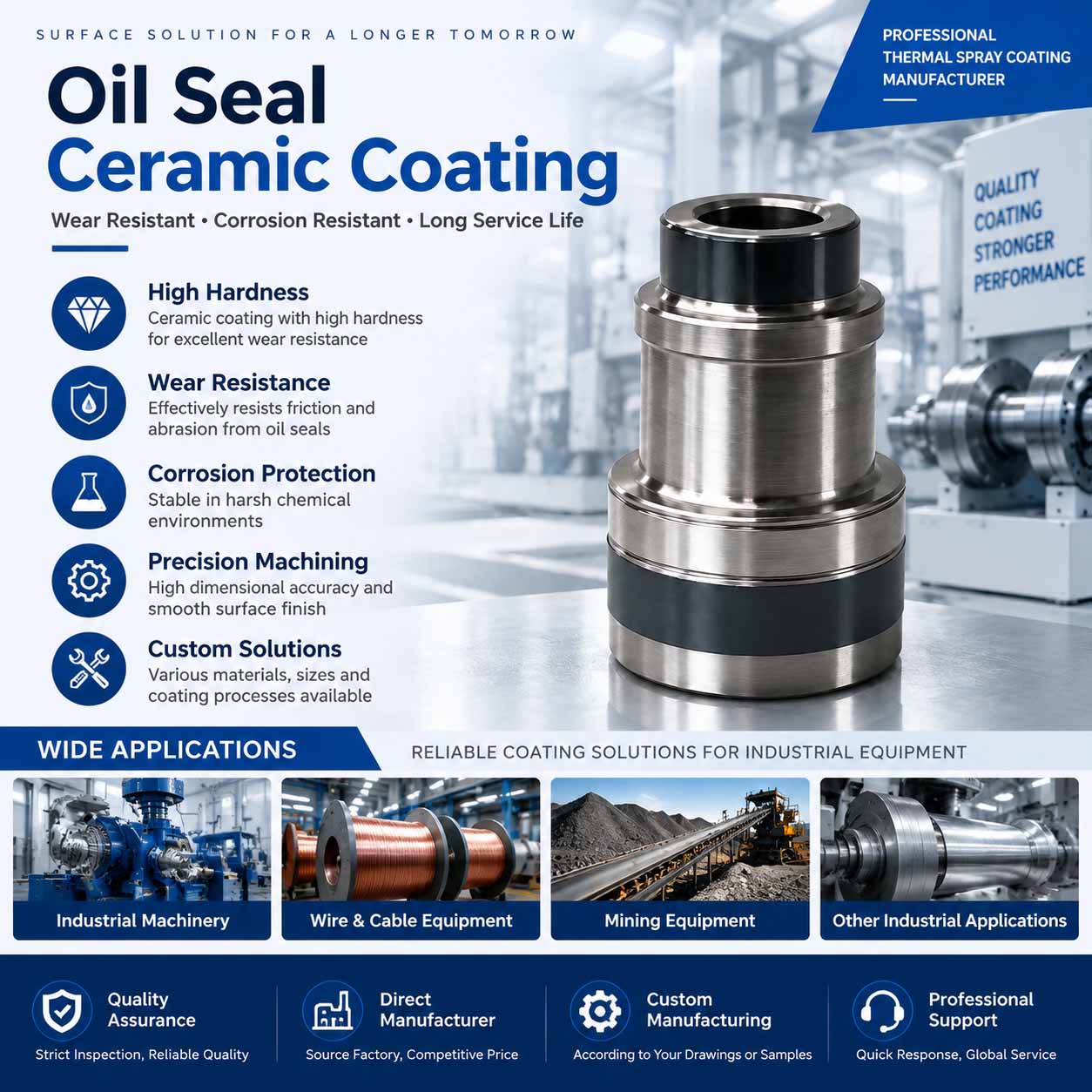
In wire, cable, and industrial production equipment, the oil seal position is a critical sealing area between rotating shafts and fixed housings.
During long-term high-speed operation, friction between the oil seal lip and shaft surface, chemical corrosion, and particle contamination can cause shaft wear, oil leakage, and unexpected equipment downtime.
Oil seal ceramic coating technology provides an effective surface protection solution. By applying a dense ceramic coating onto the metal shaft surface, it significantly improves hardness, wear resistance, and chemical stability, extending the service life of industrial components and reducing maintenance costs.
Working Principle and Advantages of Oil Seal Ceramic Coating
Oil seal ceramic coating is usually applied through:
- Thermal spraying
- HVOF (High Velocity Oxygen Fuel) spraying
Ceramic materials such as:
- Chromium oxide (Cr₂O₃)
- Aluminum oxide-titanium oxide (Al₂O₃-TiO₂)
are heated into molten or semi-molten particles and sprayed onto a pretreated shaft surface at high speed, forming a strong protective coating.
Main advantages include:
High Hardness
Ceramic coatings typically achieve:
800–1200 HV hardness
which effectively resists wear caused by oil seal contact and particle abrasion.
Low Friction Performance
The dense ceramic surface reduces friction between the shaft and oil seal, helping to:
- Reduce heat generation
- Lower energy loss
- Extend seal life
Excellent Corrosion Resistance
Ceramic coatings provide strong chemical stability against:
- Lubricating oils
- Cooling liquids
- Cleaning agents
- Industrial chemicals
Shaft Repair Capability
Worn shaft surfaces can be restored through ceramic coating, recovering original dimensions and avoiding expensive shaft replacement.
Applications in Wire and Cable Equipment
Oil seal ceramic coating is widely used for rotating components in:
- Wire production lines
- Cable manufacturing equipment
- Steel wire processing machines
Typical applications include:
Wire Drawing Machine Shafts
Protects main shafts and gearbox output shafts from:
- Metal dust
- Lubricant contamination
- Continuous friction
Stranding and Cabling Machines
Ensures reliable sealing performance during high-speed rotation and continuous operation.
Enamel Wire Equipment
Protects winding shafts from corrosion caused by:
- Enamel paint
- Solvents
- Chemical materials
Extrusion Machine Components
Prevents corrosion and wear caused by:
- Plastic melt leakage
- Carbon deposits
- High-temperature operation
Selection and Design Considerations
When selecting an oil seal ceramic coating solution, consider:
Base Material
Common substrates include:
- Carbon steel
- Alloy steel
- Stainless steel
The coating process must match the thermal expansion characteristics of the substrate.
Coating Material Selection
Different coatings are suitable for different conditions:
Chromium Oxide Coating
Suitable for general wear-resistant applications with excellent hardness and corrosion resistance.
Aluminum Oxide-Titanium Oxide Coating
Provides a balance of:
- Wear resistance
- Toughness
- Surface durability
Tungsten Carbide Coating
Recommended for:
- Heavy loads
- High-impact conditions
- Severe wear environments
Coating Thickness
Typical thickness:
0.2–0.5 mm
The thickness should balance wear life and bonding strength.
Surface Finish
After coating, the shaft surface is precision ground to:
Ra 0.2–0.4 μm
to ensure compatibility with oil seals.
Oil Seal Material Compatibility
For best performance, ceramic-coated shafts are recommended to use:
- FKM (Fluoro Rubber) seals
- PTFE seals
NBR seals should be carefully evaluated due to higher friction characteristics.
Maintenance Recommendations
Proper installation and maintenance can maximize service life:
- Inspect coating surfaces before installation.
- Ensure shaft dimensions and roundness meet requirements.
- Apply proper lubrication to oil seal lips before operation.
- Monitor temperature and leakage during regular inspections.
- Use special tools during assembly to avoid scratching the coating.
- Repair damaged areas through grinding and recoating when necessary.
Frequently Asked Questions
1. Does ceramic coating affect shaft strength?
No. The coating thickness is usually only 0.2–0.5 mm, and the surface preparation process has minimal impact on overall shaft strength. Proper design ensures safe operation.
2. Can ceramic coating peel off?
With proper surface preparation and professional spraying processes, bonding strength can exceed 70 MPa.
Coating failure is usually caused by:
- Poor preparation
- Excessive impact
- Overloading
- Incorrect operating conditions
3. Is ceramic coating suitable for all oil seals?
For optimal performance, FKM or PTFE seals are recommended. NBR seals may experience faster wear due to higher friction.
4. Is ceramic coating repair cheaper than replacing a shaft?
For large or complex shafts, ceramic coating repair is usually more economical than replacement and can significantly reduce equipment downtime.
5. How is coating quality inspected?
Common inspection methods include:
- Visual inspection
- Coating thickness measurement
- Hardness testing
- Bond strength testing
Professional suppliers can provide quality inspection reports.
6. How long does ceramic coating last?
Service life depends on:
- Load
- Speed
- Lubrication condition
- Operating environment
Under proper lubrication and clean conditions, ceramic-coated oil seal positions can last 2–5 times longer than untreated shaft surfaces.
