

Coating Service Overview
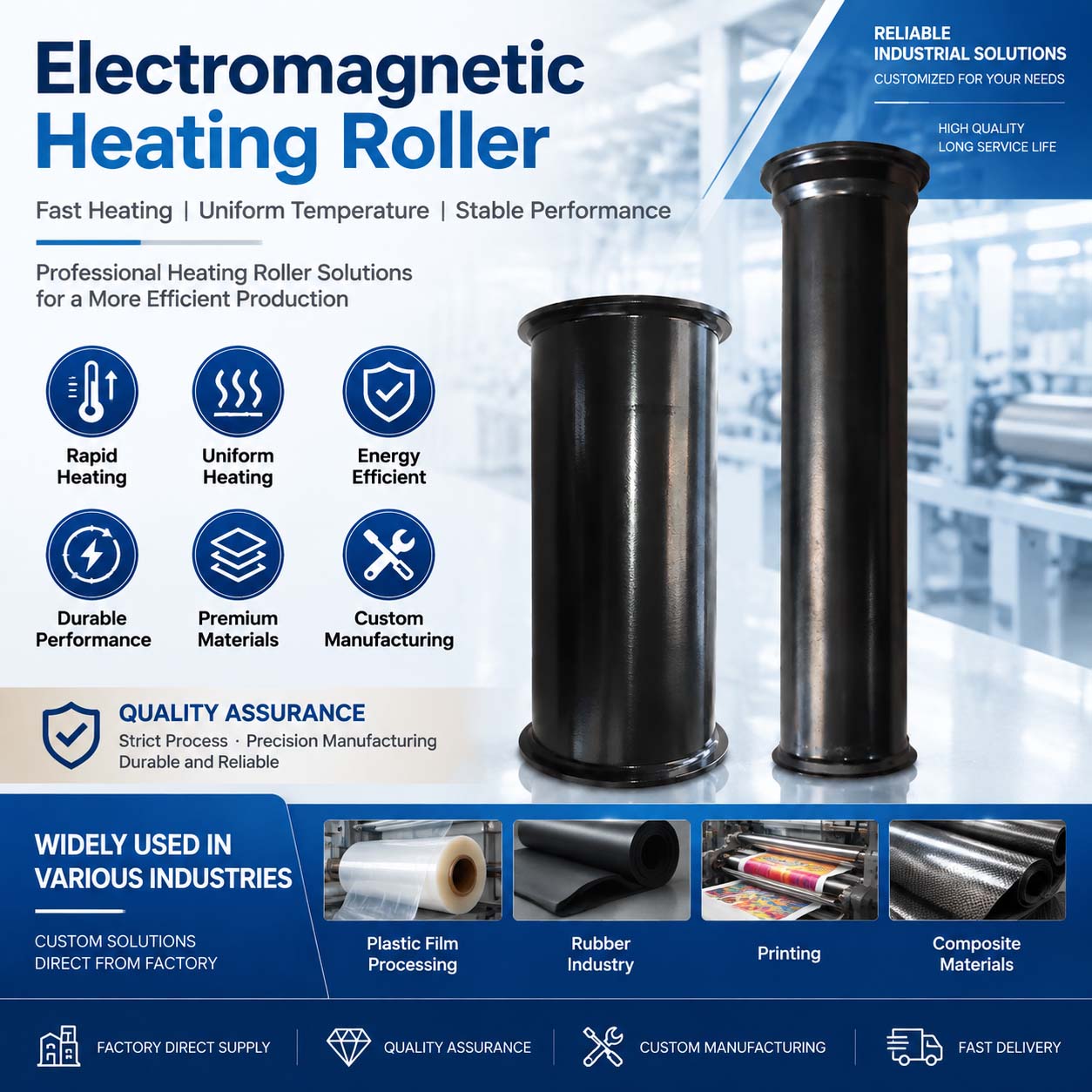
Electromagnetic heating rollers are widely used in wire and cable production, wire drawing machines, enamel wire equipment, and other industrial manufacturing systems. Their surface performance directly affects product quality, production efficiency, and equipment reliability.
Through professional thermal spray coating and surface treatment technologies, heating rollers can achieve improved wear resistance, corrosion resistance, anti-stick performance, and longer service life, reducing maintenance costs and production downtime.
This article introduces coating technologies, application fields, selection methods, and maintenance recommendations for electromagnetic heating rollers.
Common Thermal Spray Coating Technologies
Different working conditions require different surface coating solutions.
Ceramic Coating
Ceramic coatings are applied through technologies such as:
- Plasma spraying
- HVOF (High Velocity Oxygen Fuel) spraying
Common materials include:
- Chromium oxide (Cr₂O₃)
- Aluminum oxide (Al₂O₃)
Advantages:
- Excellent high-temperature resistance
- High wear resistance
- Good electrical insulation
- Strong corrosion resistance
Ceramic coatings are suitable for heating rollers operating under high temperature and high wear conditions.
Tungsten Carbide Coating
Tungsten carbide coatings, such as WC-Co, provide:
- Extremely high hardness
- Excellent resistance to abrasive wear
- Strong resistance against erosion and friction
They are widely used for wear-resistant components in:
- Cable production equipment
- Wire drawing machines
- Industrial rollers
Ceramic Plating Treatment
Ceramic plating creates a dense ceramic protective layer on the roller surface.
Benefits:
- Wear resistance
- Corrosion protection
- Improved surface durability
It is commonly applied to components such as:
- Oil seal positions
- Plungers
- Precision wear parts
Alloy Wear-Resistant Coating
Nickel-based and iron-based self-fluxing alloy powders can be sprayed and remelted to form a metallurgical bonding layer.
Features:
- Strong bonding strength
- Good resistance to metal-to-metal wear
- Suitable for medium and low impact applications
How to Select the Right Coating Solution
The coating selection should consider:
Working Conditions
Evaluate:
- Operating temperature
- Working medium
- Load type (sliding, rolling, impact)
- Corrosion environment
Base Material
The roller substrate, such as:
- Carbon steel
- Stainless steel
must be compatible with the coating process to ensure strong adhesion.
Performance Requirements
Consider:
- Hardness
- Bond strength
- Surface roughness
- Required coating thickness
Cost Efficiency
The best solution should balance:
- Initial coating cost
- Expected service life
- Maintenance frequency
Professional coating suppliers can provide customized solutions according to actual operating conditions.
Applications of Coated Electromagnetic Heating Rollers
Wire and Cable Manufacturing
Heating rollers are used in:
- Insulation extrusion lines
- Cable sheathing equipment
- Wire pulling systems
Coatings help reduce material sticking and improve surface quality.
Metal Wire Drawing
Wear-resistant coated components such as:
- Tower wheels
- Sizing rollers
- Guide rollers
can withstand high-speed wire friction while maintaining dimensional accuracy.
Enamel Wire Production
Heating rollers require:
- High-temperature resistance
- Electrical insulation
- Anti-stick performance
Ceramic coatings help prevent enamel adhesion and improve production stability.
Other Industrial Applications
Coated rollers are also used in:
- Printing machinery
- Textile equipment
- Paper processing
- Packaging machinery
They provide wear resistance and anti-stick performance for various guide rollers and pressure rollers.
Maintenance Recommendations
Proper maintenance extends coating service life:
Cleaning
- Remove surface contamination regularly.
- Avoid hard tools that may scratch the coating.
Inspection
During equipment shutdown:
- Check for coating peeling
- Inspect cracks and abnormal wear
- Record coating condition
Protection
For long-term storage:
- Apply anti-rust protection.
- Store in a dry environment.
- Avoid impact damage.
Repair
If local coating damage occurs:
- Evaluate the damaged area.
- Repair locally or perform recoating when necessary.
Frequently Asked Questions
1. Does coating affect heating efficiency?
Normally, the impact is minimal. Ceramic coatings are usually only 0.2–0.5 mm thick and allow effective heat transfer. Some coatings may even improve thermal radiation performance.
2. Why does coating peel off?
Possible causes include:
- Poor substrate preparation
- Incorrect spraying parameters
- Thermal expansion mismatch
- Overloading or impact during operation
A complete evaluation of material, process, and working conditions is required.
3. Ceramic coating or tungsten carbide coating: which is better?
- Ceramic coating: better for high temperature, insulation, and corrosion resistance.
- Tungsten carbide coating: better for abrasive wear and impact resistance.
The choice depends on actual operating conditions.
4. How long does coating repair take?
Processing time depends on:
- Roller size
- Coating type
- Workload
Normally, standard projects require approximately 3–7 working days.
5. Can old rollers be recoated?
Yes. After removing the old coating and checking the substrate condition, worn rollers can be restored through surface preparation and new coating application.
6. What surface roughness can be achieved after coating?
Sprayed surfaces usually have a roughness of:
Ra 3.2–12.5 μm
After grinding or polishing, the surface can reach:
Ra < 0.4 μm
to meet different production requirements.
