

Coating Service Overview
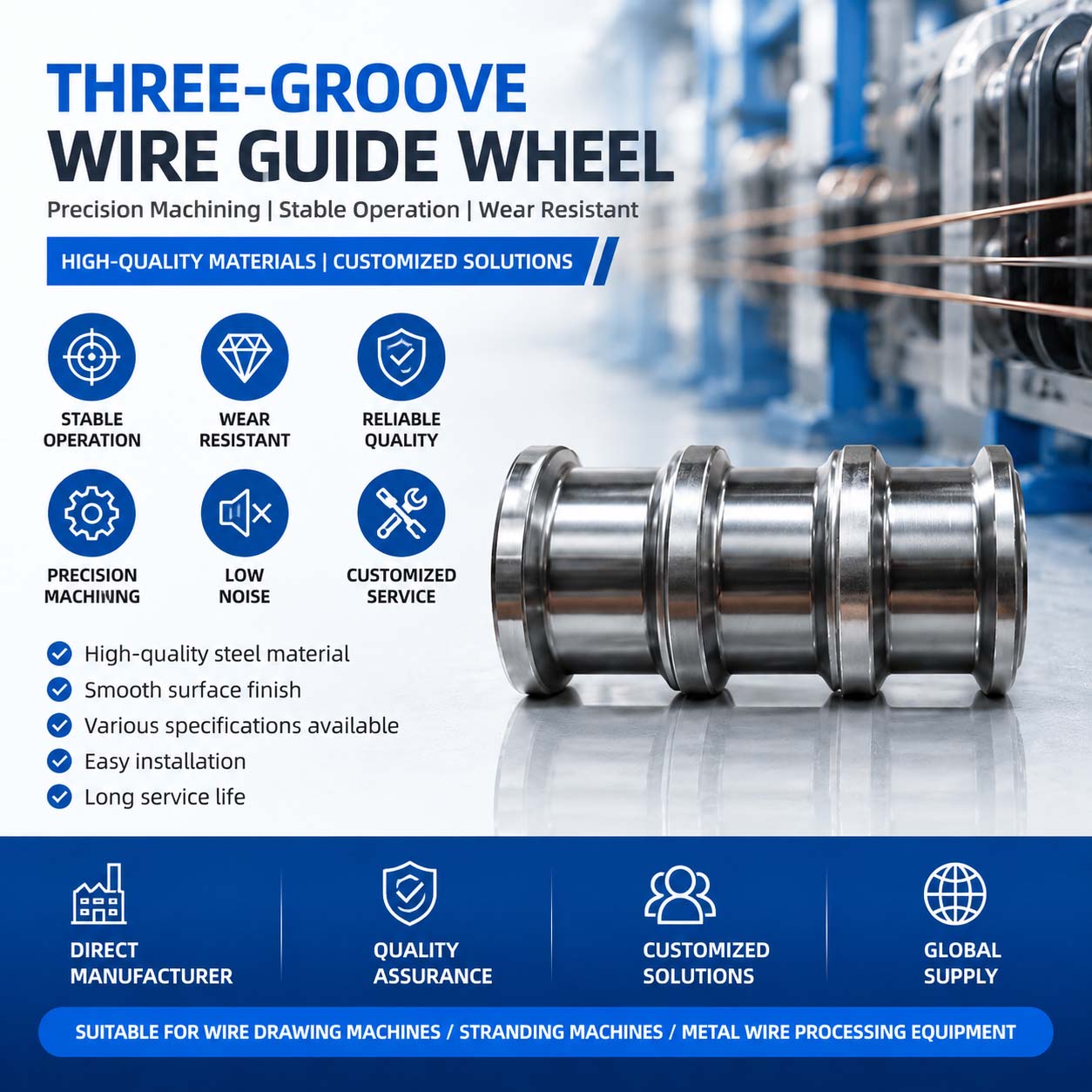
In wire and cable manufacturing, metal wire drawing, and related industries, wire guide wheels are critical components for guiding wires and reducing friction during production. A three-groove wire guide wheel can guide multiple wires simultaneously, improving production efficiency. However, continuous contact with high-speed moving wires causes surface wear over time.
Excessive wear can lead to wire scratches, unstable operation, wire breakage, and unexpected equipment downtime. Therefore, applying proper surface wear-resistant treatment technologies for preventive protection or restoration after wear is an effective way to improve production reliability and reduce spare part costs.
Common Wear Problems of Three-Groove Wire Guide Wheels
Three-groove guide wheels are usually manufactured from metal substrates such as steel or aluminum alloy. During operation, the wire slides continuously inside the grooves, causing several types of wear:
Abrasive Wear
Hard particles or impurities on the wire surface create cutting action between the wire and guide wheel, resulting in scratches and groove damage.
Adhesive Wear
Under high temperature and pressure, the wire may partially bond with the guide wheel surface. The material is then torn away, causing surface roughness and material transfer.
Fatigue Wear
Repeated contact stress can create micro-cracks on the surface or subsurface, eventually leading to coating failure and pitting.
Corrosion Wear
Moisture, chemicals, or acidic environments can accelerate material loss when corrosion and mechanical wear occur together.
These wear mechanisms often appear simultaneously, causing loss of groove accuracy, increased wire vibration, and reduced product quality.
Wear-Resistant Surface Treatment Technologies
For three-groove wire guide wheels, common surface enhancement and repair technologies include thermal spraying, hardfacing, and laser cladding. Among them, thermal spray coating is widely used due to its wide material selection, low heat input, and excellent repair capability.
Ceramic Thermal Spray Coating
Using plasma spraying or HVOF (High Velocity Oxygen Fuel) spraying, ceramic powders such as chromium oxide (Cr₂O₃) and aluminum oxide (Al₂O₃) are deposited onto the guide wheel surface to form a high-hardness protective layer.
Ceramic coatings provide:
- Excellent wear resistance;
- High-temperature stability;
- Corrosion resistance;
- Low friction characteristics.
They are especially suitable for high-speed wire processing applications.
Tungsten Carbide Thermal Spray Coating
Tungsten carbide coating uses WC particles as the hard phase with cobalt or nickel binders. Through HVOF spraying technology, a dense metal-ceramic coating is formed.
Main advantages include:
- Hardness up to HV1100–1300;
- Excellent impact and abrasion resistance;
- Strong coating adhesion;
- Long service life.
The typical coating thickness is 0.1–0.3 mm. After precision grinding, the guide wheel can be restored to its original dimensions.
Other Repair Technologies
Hardfacing
Wear-resistant welding materials are applied to damaged areas and then machined to size. This method is suitable for large components but generates higher heat input and may cause deformation.
Laser Cladding
A high-energy laser beam melts alloy powder onto the surface to form a metallurgically bonded coating. It offers low dilution and small deformation but has higher processing costs.
Thermal Spray Repair Process
A typical three-groove wire guide wheel repair process includes:
1. Cleaning and Inspection
Remove oil, rust, and contaminants. Measure wear levels and inspect the substrate for cracks or structural damage.
2. Surface Preparation
Grit blasting is performed to increase surface roughness and improve coating adhesion.
3. Bonding Layer Application (Optional)
A nickel-aluminum bonding layer can be applied to enhance coating strength.
4. Functional Coating Spraying
Ceramic or tungsten carbide coatings are applied according to the required performance and operating conditions.
5. Precision Finishing
Diamond grinding is used to restore groove dimensions, surface roughness, and geometric accuracy.
6. Quality Inspection
Final inspection includes:
- Coating thickness;
- Hardness;
- Surface quality;
- Bond strength.
After professional repair, guide wheels can achieve performance equal to or better than new components, while repair costs are typically only 30%–50% of replacement costs.
Coating Selection and Maintenance Guide
The correct coating should be selected according to wire material, speed, load, and working environment.
- Ceramic coating: Suitable for high-speed fine wire applications such as copper wire and alloy wire, offering low friction and excellent surface stability.
- Tungsten carbide coating: Recommended for steel wire, heavy-load applications, and environments with severe abrasive wear.
- Aluminum alloy guide wheels: Require controlled spraying temperature. Low heat input processes such as HVOF or cold spray may be preferred.
Regular inspection of groove wear is recommended. Remove wire residues and prevent localized damage. When deep grooves or increased wire vibration appear, repair should be considered.
Frequently Asked Questions
When should a three-groove guide wheel be repaired?
Repair is recommended when groove wear exceeds approximately 0.2 mm or when groove deformation affects wire stability.
Will thermal spray coatings peel off?
With proper surface preparation and optimized spraying parameters, coating bonding strength can exceed 70 MPa and remain stable under normal operating conditions.
Can repaired guide wheels match new components?
High-quality coating materials and professional repair processes can provide wear resistance equal to or better than standard new parts.
Can all guide wheels be repaired?
Most steel, stainless steel, and aluminum alloy guide wheels can be repaired. The coating process must be selected according to substrate characteristics.
How long does the repair take?
The standard repair cycle is usually 3–7 working days, depending on wear condition and order quantity.
How to choose the right coating?
Ceramic coatings are preferred for high-speed, low-friction applications, while tungsten carbide coatings are ideal for heavy loads, impact, and severe abrasive wear.
Professional thermal spray coating solutions help three-groove wire guide wheels achieve higher wear resistance, longer service life, and improved production efficiency for global wire processing industries.
