

Coating Service Overview
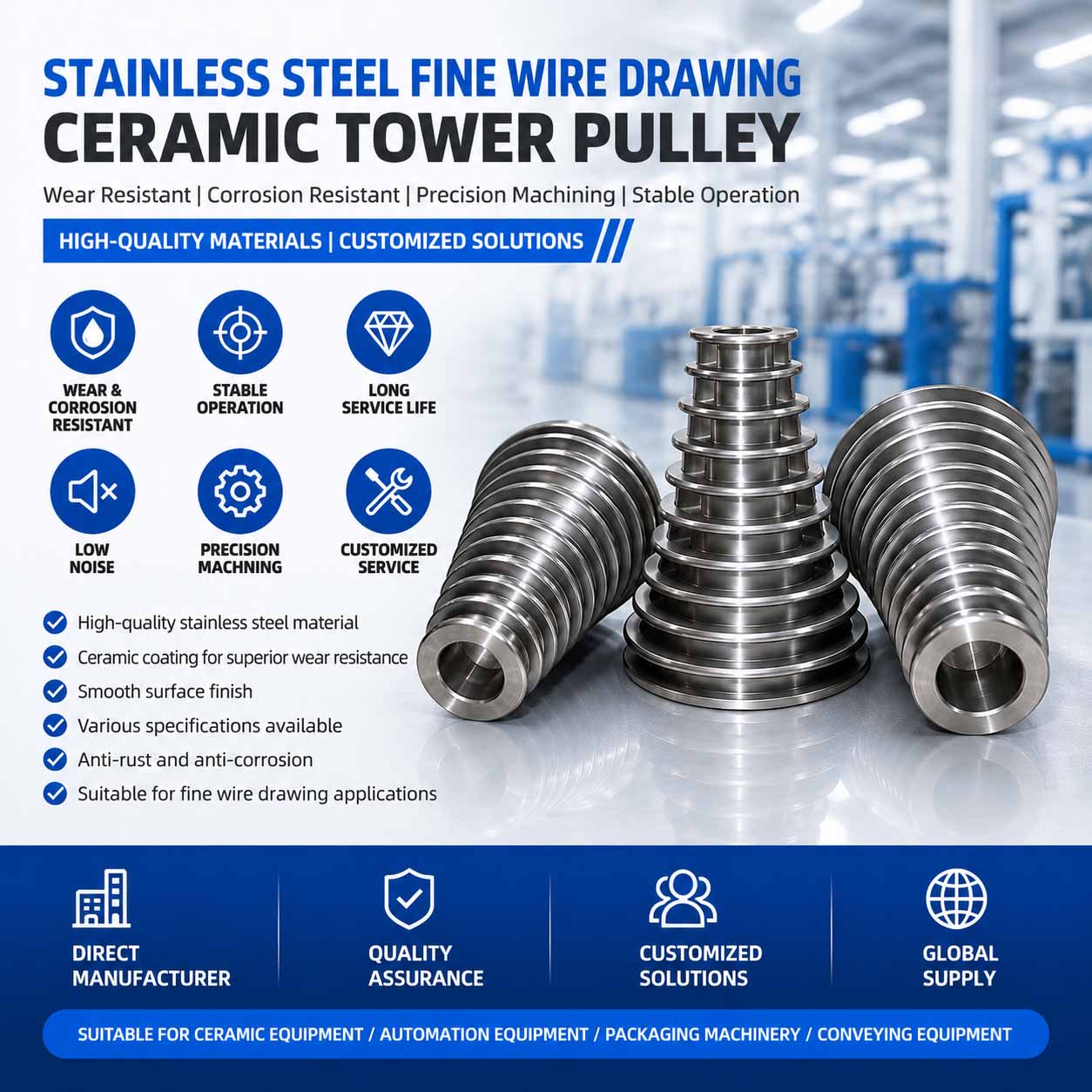
In wire and cable manufacturing, as well as metal wire drawing industries, guide wheels and tower pulleys are critical components that directly contact wire materials and withstand high-speed friction and tension. Their surface wear resistance has a direct impact on production efficiency and product quality.
This article introduces stainless steel fine wire drawing ceramic tower pulleys and aluminum alloy wear-resistant surface treatment technologies, covering their features, applications, coating options, and maintenance recommendations.
Features of Stainless Steel Fine Wire Drawing Ceramic Tower Pulley
A stainless steel fine wire drawing ceramic tower pulley uses a stainless steel substrate combined with a ceramic wear-resistant coating applied through advanced thermal spray technology.
The combination of stainless steel strength and ceramic performance provides:
- High hardness;
- Excellent wear resistance;
- Corrosion resistance;
- Low friction performance.
Common ceramic coating materials include chromium oxide (Cr₂O₃) and aluminum oxide (Al₂O₃). The coating thickness is typically 0.2–0.5 mm, with hardness exceeding HRC70 and surface roughness controlled below Ra0.4.
These tower pulleys are widely used for fine wire drawing applications, including:
- Copper wire;
- Aluminum wire;
- Alloy wire;
- Stainless steel wire.
The smooth ceramic surface reduces wire scratches, lowers friction, improves wire quality, and extends component service life.
Aluminum Alloy Wear-Resistant Surface Treatment
Aluminum alloy is widely used for guide wheels and wire rollers due to its lightweight and excellent machinability. However, its low hardness and limited wear resistance require surface strengthening treatment.
Common solutions include:
Ceramic Thermal Spray Coating
Using plasma spraying or HVOF (High Velocity Oxygen Fuel) spraying, ceramic materials such as aluminum oxide-titanium oxide (Al₂O₃-TiO₂) are deposited onto aluminum alloy surfaces.
Advantages:
- Significantly improved surface hardness;
- Excellent wear resistance;
- High-temperature stability;
- Good corrosion resistance.
Tungsten Carbide Coating
Through HVOF spraying, WC-Co tungsten carbide coating provides extremely high hardness and wear resistance.
It is suitable for:
- Heavy-load applications;
- High-friction environments;
- Industrial components requiring long service life.
Hard Anodizing
Hard anodizing creates a dense aluminum oxide layer through electrochemical oxidation. It improves surface hardness but generally provides lower wear resistance compared with thermal spray coatings.
Thermal spray coatings on aluminum alloy substrates offer strong bonding strength, low porosity, and excellent corrosion protection, making them ideal for demanding industrial applications.
Applications and Selection Guide
Wire Drawing Machine Tower Pulleys and Guide Wheels
Tower pulleys and guide wheels in wire drawing machines operate under continuous wire friction.
- Stainless steel ceramic tower pulleys are ideal for fine wire drawing due to their smooth surface and low friction.
- Aluminum alloy guide wheels with ceramic or tungsten carbide coatings are suitable for specific tension control and medium-speed wire processing applications.
Selection should consider:
- Wire material;
- Wire diameter;
- Drawing speed;
- Wire tension;
- Operating environment.
Enamel Wire Machine Guide Wheels
Enamel wire guide wheels require excellent surface smoothness, corrosion resistance, and heat resistance. Ceramic coatings help prevent enamel film damage while maintaining stable operation at high speeds.
Other Wire Guide Components
In cable equipment, textile machinery, and fiber processing equipment, aluminum alloy guide wheels with ceramic or tungsten carbide coatings improve wear resistance and extend service intervals.
Maintenance Recommendations
To maximize coating performance:
- Regularly inspect coating wear and surface damage;
- Avoid impact or hard tool contact, as ceramic coatings are hard but brittle;
- Clean surfaces with soft cloth or suitable brushes;
- Keep components dry during storage;
- Ensure proper alignment and concentricity during installation.
For aluminum alloy guide wheels, avoid strong acids and alkalis that may damage the substrate.
Frequently Asked Questions
What wire materials are suitable for stainless steel ceramic tower pulleys?
They are suitable for fine wire drawing of copper wire, aluminum wire, alloy wire, and stainless steel wire, typically with wire diameters from 0.1–1.0 mm.
What hardness can aluminum alloy achieve after ceramic coating?
Depending on coating materials and processes, surface hardness can reach approximately HRC60–75.
How long can ceramic-coated tower pulleys last?
Service life depends on wire material, speed, tension, and lubrication conditions. In many applications, ceramic coatings can extend service life by 3–5 times compared with uncoated steel wheels.
Will coating affect high-speed balance?
No. Professional thermal spraying followed by precision grinding can maintain dimensional accuracy and dynamic balance.
Can damaged coatings be repaired?
Yes. Old coatings can be removed and recoated through professional thermal spray repair processes.
How to choose ceramic coating or tungsten carbide coating?
- Ceramic coating: Best for high-speed applications requiring low friction, insulation, and corrosion resistance.
- Tungsten carbide coating: Best for heavy loads, severe wear, and abrasive environments.
Advanced ceramic and tungsten carbide coating technologies provide reliable wear protection solutions for wire drawing equipment, helping manufacturers improve productivity, reduce maintenance costs, and extend component life.
