

- Service: CR1002 Ceramic Coated Guide Wheel Assembly
- Category: Modular Guide Wheels
Coating Service Overview
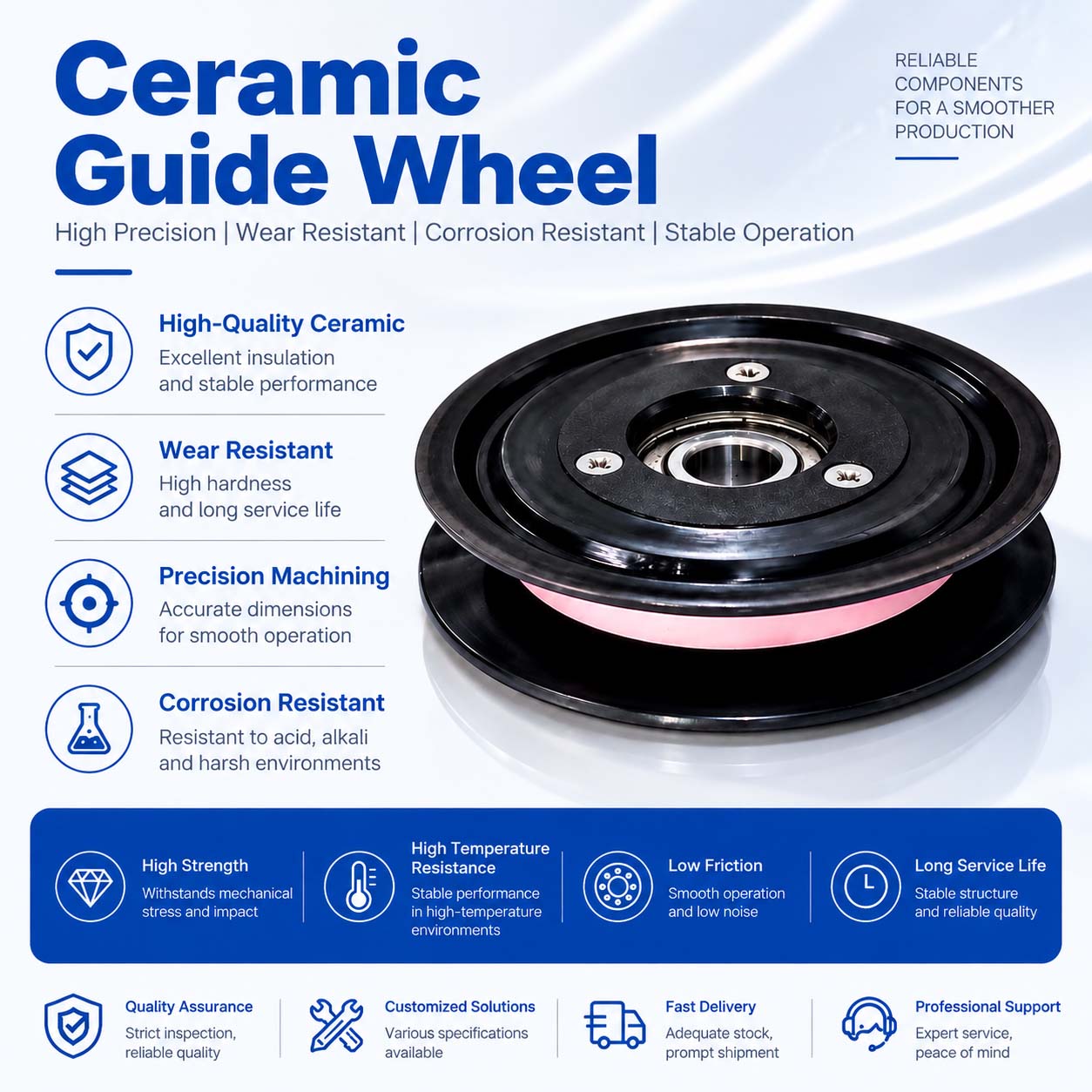
In precision manufacturing, guide wheels are critical transmission components, and their surface performance directly affects equipment efficiency, stability, and product quality.
The CR1002 Ceramic Coated Guide Wheel Assembly combines advanced ceramic thermal spray coating and alloy coating technology. With a lightweight design of only 6.5 g, it provides excellent wear resistance, corrosion resistance, and surface protection for wire, cable, textile, printing, and other precision industries.
Product Overview
CR1002 is a modular guide wheel with a metal substrate treated by ceramic or alloy coating processes to improve surface hardness and durability.
With its compact structure and lightweight design, CR1002 is suitable for high-speed rotation and continuous contact applications.
Available coating materials include:
- Chromium oxide ceramic coating
- Alumina ceramic coating
- Tungsten carbide alloy coating
Different coating solutions can be selected according to friction conditions, operating speed, temperature, and material requirements.
Coating Technology and Features
Ceramic Thermal Spray Coating
Ceramic powder is melted and sprayed onto the guide wheel surface through thermal spray technology, forming a dense protective ceramic layer.
Main advantages include:
- High hardness
- Low friction coefficient
- Excellent wear resistance
- Electrical insulation
- Good resistance to high temperature and chemical corrosion
Ceramic coatings are ideal for applications requiring smooth surface contact and long service life.
Alloy Coating
Alloy coatings such as nickel-based, cobalt-based, and tungsten carbide coatings provide:
- Extremely high wear resistance
- Excellent impact resistance
- Strong bonding with the substrate
- Reliable performance under heavy-load conditions
The coating thickness can be customized according to application requirements. Typical thickness ranges from 0.1–0.5 mm, balancing wear protection and dimensional accuracy.
Applications
CR1002 ceramic coated guide wheel assemblies are widely used in precision guiding applications.
Wire and Cable Manufacturing
Used in haul-off wheels, wire guide wheels, and cable processing equipment to reduce surface scratches and extend component life.
Textile Machinery
Used in spinning and winding processes. Ceramic coatings reduce fiber wear, prevent hairiness, and improve production stability.
Printing and Packaging Equipment
The wear-resistant and anti-stick surface helps ensure smooth transportation of films, paper, and other materials.
Other Precision Transmission Systems
Suitable for lightweight guide wheel assemblies where low rotational inertia, high wear resistance, and stable operation are required.
Selection and Maintenance
Selection Recommendations
When selecting CR1002, consider:
Operating Conditions
Evaluate load, speed, temperature, and contact materials to select the most suitable coating type.
Dimensions
Confirm the wheel outer diameter, bore size, thickness, and installation requirements to ensure compatibility with the equipment.
Coating Thickness
The optimal coating thickness should be selected according to wear allowance and dimensional accuracy requirements.
Maintenance Guidelines
To maintain performance and extend service life:
- Regularly inspect the coating surface for peeling, cracks, or abnormal wear.
- Clean with a soft cloth or neutral cleaning agent.
- Avoid using sharp or hard tools that may damage the coating.
- Store in a dry environment away from corrosive substances.
- Replace the guide wheel when coating wear reaches the substrate or affects product quality.
Frequently Asked Questions
Will the ceramic coating peel off?
Under normal operating conditions, ceramic coatings have strong bonding strength and are not easily detached. However, severe impact or overload operation may cause local coating damage.
Is the 6.5 g lightweight design suitable for high-speed operation?
Yes. The lightweight structure reduces rotational inertia, allowing faster acceleration, lower energy consumption, and reduced vibration during high-speed operation.
How do I choose between ceramic and alloy coatings?
Ceramic coatings are recommended for applications requiring high temperature resistance, electrical insulation, and corrosion resistance.
Alloy coatings are more suitable for heavy-load applications requiring impact resistance and high wear resistance.
Does coating thickness affect guide wheel accuracy?
The coating thickness is typically controlled within 0.1–0.5 mm. Additional machining and grinding after coating ensure the final dimensional accuracy.
Can CR1002 be recoated after wear?
Yes. Worn guide wheels can often be refurbished by removing the old coating and applying a new coating after evaluating the substrate condition.
Can CR1002 be used in food or medical applications?
Ceramic coatings are generally chemically stable and non-toxic, but specific applications require confirmation that the coating materials and processes meet relevant industry standards.
Customized Ceramic Coated Guide Wheel Solutions
We provide customized CR1002 ceramic coated guide wheel assemblies with different coating materials, dimensions, groove designs, and surface treatments.
Through advanced thermal spray and alloy coating technologies, CR1002 delivers high wear resistance, stable operation, and extended service life for demanding precision manufacturing applications.
