

Coating Service Overview
In textile and chemical fiber production, the measuring drum is a critical component that directly affects measurement accuracy and service life. By applying an Al₂O₃-TiO₂ (Alumina-Titania) ceramic coating through thermal spraying technology, the wear resistance and corrosion resistance of the measuring drum can be significantly improved, extending replacement intervals and reducing maintenance costs.
This article introduces the coating technology, performance advantages, applications, and maintenance recommendations.
Coating Material and Process Features
The coating uses Al₂O₃-TiO₂ ceramic material, applied through advanced thermal spraying processes such as plasma spraying or HVOF (High Velocity Oxygen Fuel) spraying.
The coating combines the high hardness of alumina with the toughness of titanium oxide, forming a dense protective layer with strong bonding strength.
Main Technical Parameters:
- Coating Material: Al₂O₃-TiO₂ (Alumina-Titania)
- Coating Thickness: 0.2-0.3 mm
- Bond Strength: ≥15 MPa (typical value)
- Porosity: <3% (typical value)
- Surface Roughness: Can be ground to Ra ≤0.4 μm
The coating thickness can be adjusted according to operating conditions, but sufficient machining allowance should be reserved before coating.
Performance Advantages
The Alumina-Titania coating provides the measuring drum with:
Excellent Wear Resistance
The coating hardness can exceed HRC60, effectively resisting sliding wear caused by yarns and fiber bundles.
Corrosion Resistance
The coating provides excellent chemical stability against textile oils, moisture, and mild acidic or alkaline environments.
Thermal Shock Resistance
The coating can withstand temperature fluctuations and maintain stable performance without easy peeling.
Dimensional Stability
The dense coating minimizes dimensional changes during long-term operation, helping maintain measurement accuracy.
Applications
Al₂O₃-TiO₂ coated measuring drums are widely used in textile and chemical fiber equipment, including:
- High-speed spinning lines where yarn speed and wear conditions are demanding.
- Texturing and winding equipment requiring stable length measurement.
- Fiber processing applications involving oil agents or corrosive environments.
- Precision winding systems requiring high measurement accuracy.
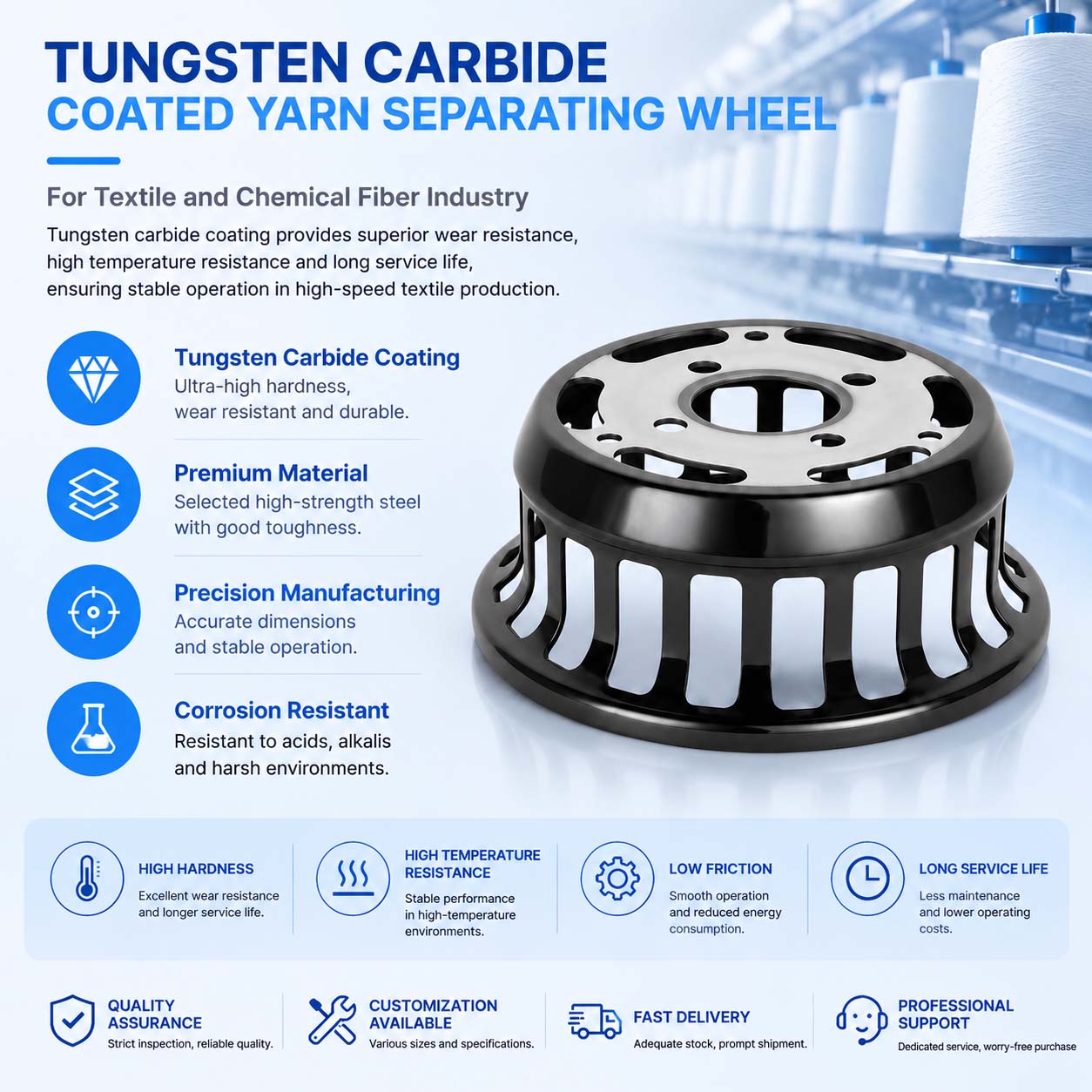
Similar coating technology can also be applied to textile components such as ceramic guide wheels and yarn separating wheels.
Selection and Maintenance Guidelines
Selection Considerations
When selecting coating processing services, consider:
- Provide measuring drum material, dimensions, and tolerance requirements for coating evaluation.
- Confirm operating speed, contact materials, and working environment to determine suitable coating specifications.
- New components should reserve coating allowance; worn components require inspection of substrate condition before refurbishment.
Maintenance Tips
To extend coating service life:
- Regularly inspect the coating surface for cracks, peeling, or abnormal wear.
- Clean with soft materials or neutral cleaning agents. Avoid scratching the surface.
- Store in a dry environment away from corrosive atmospheres.
- For local coating damage, consult professionals to evaluate repair possibilities.
Frequently Asked Questions
What is the difference between Alumina-Titania and tungsten carbide coatings?
Alumina-Titania is a ceramic coating with excellent insulation and high-temperature oxidation resistance, suitable for textile applications with corrosive environments.
Tungsten carbide is a metal-ceramic coating with higher hardness and better wear resistance, but its corrosion resistance may be lower. The correct choice depends on actual working conditions.
Can the coating thickness be customized?
Yes. The standard thickness is 0.2-0.3 mm, and adjustments can be made according to application requirements. The effect on dimensions and coating stress should be evaluated.
How long does the coating process take?
For batch processing, the typical production cycle is around 5-10 working days, depending on quantity, surface preparation, and machining requirements.
Is grinding required after coating?
Yes. The sprayed surface is usually rough after coating. Precision grinding is required to achieve the required dimensions and surface finish.
Can old measuring drums be refurbished?
Yes. Old measuring drums can be restored by removing the damaged coating, repairing the substrate, applying a new coating, and machining back to specifications.
How is coating bonding strength guaranteed?
Strong coating adhesion is achieved through strict surface preparation, sandblasting, preheating, and controlled spraying parameters. Inspection reports can be provided according to customer requirements.
Conclusion
Al₂O₃-TiO₂ Ceramic Coating Processing for Measuring Drums provides an effective surface protection solution for textile and chemical fiber equipment. With excellent wear resistance, corrosion protection, thermal stability, and dimensional accuracy, it helps improve equipment reliability and extend component service life.
