

Coating Service Overview
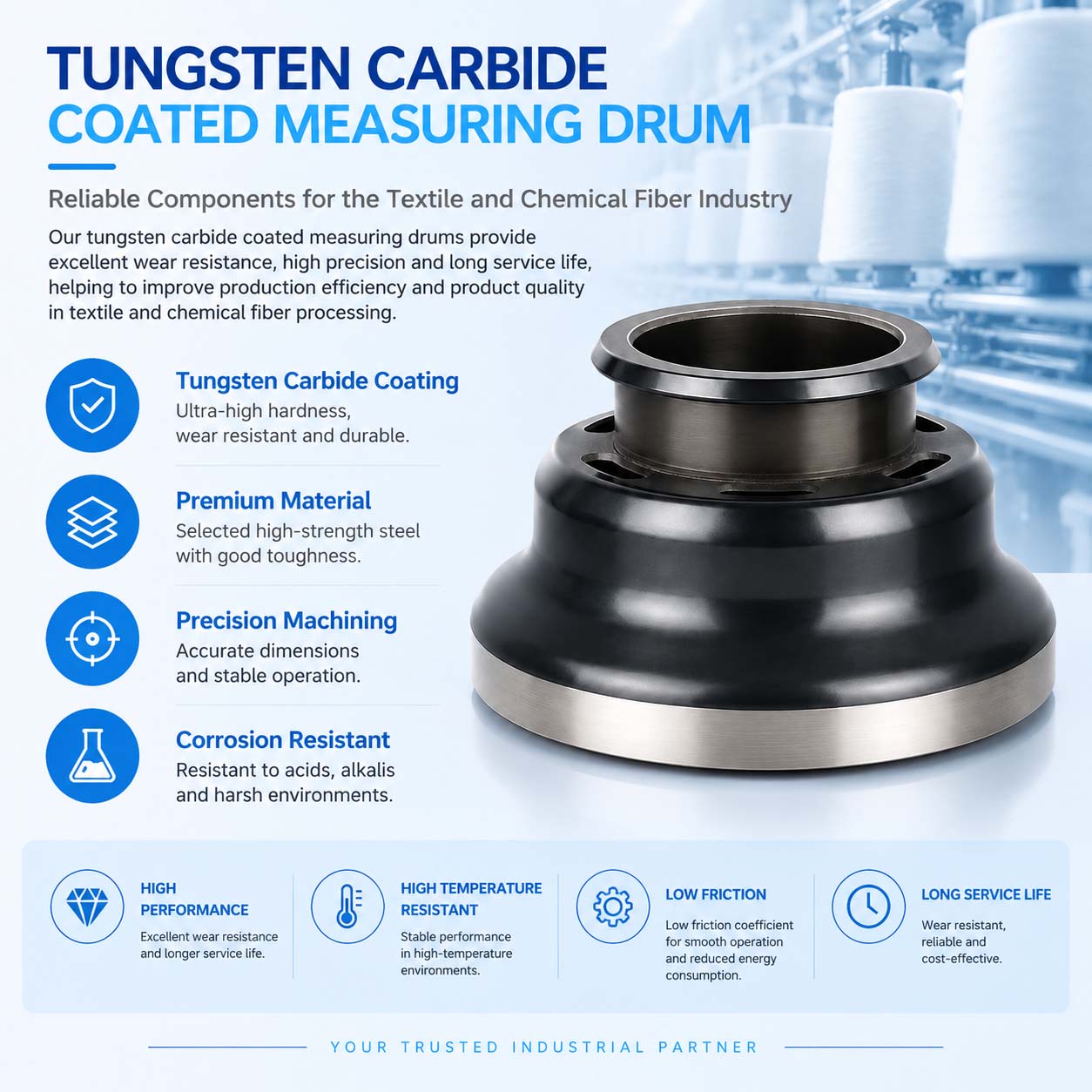
In the textile and chemical fiber industry, the surface performance of components such as measuring drums and guide wheels directly affects production efficiency and product quality.
By applying Al₂O₃-TiO₂ (Alumina-Titania) ceramic coating technology, these components can achieve significantly improved wear resistance, corrosion resistance, and electrical insulation performance.
This article introduces coating materials, thickness, applications, selection guidelines, and maintenance methods for measuring drums, ceramic coated guide wheels, and aluminum guide wheels.
Coating Material and Thickness
The products use Al₂O₃-TiO₂ ceramic coating, applied to the substrate surface through advanced thermal spraying technology to form a dense protective layer.
Main Parameters:
- Coating Material: Al₂O₃-TiO₂ (Alumina-Titania)
- Coating Thickness: 0.2-0.3 mm
- Process: Thermal spraying coating
The Alumina-Titania coating provides:
- High hardness
- Low friction coefficient
- Excellent chemical stability
- Good wear and corrosion resistance
It is suitable for high-speed operation and harsh industrial environments.
Product Types and Applications
Measuring Drum
Measuring drums are used for accurate length measurement of fiber bundles during chemical fiber spinning processes.
The surface requires stable friction characteristics, high wear resistance, and dimensional accuracy. The Alumina-Titania coating helps maintain consistent performance over long-term operation and reduces measurement errors.
Ceramic Coated Guide Wheels and Aluminum Guide Wheels
Ceramic coated guide wheels (also known as ceramic sprayed guide wheels) and aluminum guide wheels are widely used for guiding and transporting wires, cables, and yarns.
The aluminum alloy substrate provides lightweight advantages, while the ceramic coating adds:
- Improved wear resistance
- Better corrosion protection
- Electrical insulation performance
- Longer service life
Typical applications include:
- Textile and chemical fiber industry: yarn guides, yarn separating wheels, tension control rollers
- Wire and cable industry: wire guide wheels and insulated guide components
- Other industrial applications: film, tape, and material conveying rollers
Selection Guidelines
When selecting measuring drums or guide wheels, consider:
Substrate Material
- Aluminum alloy: suitable for lightweight, high-speed applications
- Steel substrate: suitable for heavy-load conditions
Coating Thickness
The standard coating thickness is 0.2-0.3 mm. Customized thickness can be considered according to application requirements.
Surface Roughness
The final surface finish should be selected according to the friction requirements of fibers or wire materials.
Operating Environment
Alumina-Titania coating performs well in applications involving chemical exposure, humidity, or elevated temperatures.
Maintenance Tips
Proper maintenance helps extend coating service life:
- Regularly inspect the coating surface for cracks, peeling, or abnormal wear.
- Clean with a soft cloth or neutral cleaning agent. Avoid scratching the coating.
- Store components in a dry and ventilated environment to prevent substrate corrosion.
- Avoid impact during installation and ensure proper bearing lubrication to prevent uneven wear.
Frequently Asked Questions
What is the difference between Alumina-Titania and tungsten carbide coatings?
Alumina-Titania coating provides excellent insulation, heat resistance, and oxidation resistance, making it suitable for textile and chemical fiber applications.
Tungsten carbide coating offers higher hardness and superior wear resistance, making it more suitable for heavy-load wear applications.
The correct coating should be selected according to the working conditions.
Can the coating thickness be customized?
Yes. The standard thickness is 0.2-0.3 mm, but customized thickness is available after evaluating dimensional requirements and coating stress.
Will ceramic coating affect aluminum guide wheel conductivity?
Yes. Ceramic coatings are electrically insulating. If electrical conductivity is required, special coating solutions or conductive areas should be considered.
Does coating affect measuring drum accuracy?
Coating uniformity and surface roughness can influence measurement accuracy. Professional coating and finishing processes are used to maintain consistency, while final accuracy should be verified with system calibration.
When should the coating be refurbished?
Refurbishment is recommended when visible wear, local peeling, abnormal friction, or performance decline occurs. Professional inspection is recommended before recoating.
What materials are suitable for ceramic coated guide wheels?
They are suitable for chemical fibers, yarns, cables, and similar materials. They are not recommended for sharp metal wires that may damage the coating surface.
Conclusion
Al₂O₃-TiO₂ Ceramic Coating Technology provides an effective surface protection solution for measuring drums, ceramic guide wheels, and aluminum guide wheels. With excellent wear resistance, corrosion protection, insulation performance, and stable surface quality, it helps improve production efficiency and extend component service life in textile, chemical fiber, wire, and cable industries.
