

Coating Service Overview
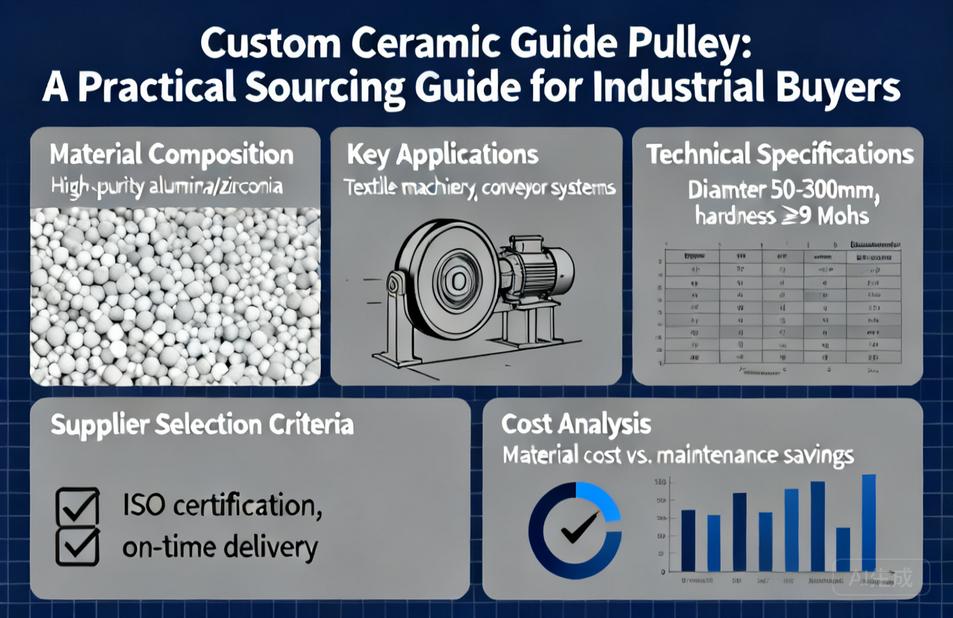
A custom ceramic guide pulley is a wire or thread guidance component in which the contact surface is made from technical ceramic, usually alumina or zirconia, and the geometry, mounting style and ceramic insert are produced to match a specific machine or process. It is commonly used wherever wire, cable, fiber, thread or tape must change direction with low friction and minimal wear, such as wire drawing lines, coil winding equipment, textile machinery, fiber optic production and automated handling systems. For overseas buyers, the main question is rarely whether ceramic pulleys work, but how to specify a custom version that fits the machine, the material being guided and the maintenance plan.
Product Overview and Working Principle
A guide pulley does not drive the material; it redirects it. The ceramic surface provides a hard, smooth contact zone that resists abrasion from moving wire or fiber, while the bearing or bushing in the hub allows the pulley to rotate freely. In many designs the ceramic is a ring or insert fitted into a metal or plastic hub, and the pulley may be fixed, idler-type or mounted on a shaft. The working principle is simple: reduce sliding friction, spread the contact load over a controlled radius, and keep the running path stable. When the pulley radius, groove profile and alignment are correct, tension variation and surface damage are reduced.
Key Features Buyers Look For
Purchasers evaluating a ceramic guide pulley usually focus on features that affect uptime rather than catalog appearance. Important points include a smooth ceramic contact surface, a groove or flat profile matched to the product being guided, low rotational resistance, and a hub design that fits the existing shaft or bracket. Corrosion resistance and electrical insulation are also relevant in wet or electrically sensitive processes. Buyers should confirm whether the pulley is intended as a fixed guide or a rotating idler, because the mounting and bearing arrangement differ. Edge radius and surface finish matter as well, since sharp transitions can mark soft wire or fiber.
Materials and Construction
Technical ceramics are chosen for wear resistance and low friction, but the grade should match the application. Alumina ceramic is common for general wire and thread guidance, while zirconia ceramic is often considered where higher toughness is useful. The hub may be machined from aluminum, stainless steel or engineering plastic, depending on weight, corrosion exposure and mounting requirements. The ceramic-to-hub connection is a critical construction detail; buyers should ask how the insert is retained and whether the design allows replacement of the ceramic part alone. A well-designed custom pulley also considers bearing type, shaft fit, lubrication needs and the operating environment, including dust, coolant or cleaning chemicals.
Industrial Applications
Ceramic guide pulleys appear in many processes where a moving linear material must be routed without damage. Typical industrial applications include wire drawing and annealing lines, cable and rope manufacturing, coil winding, textile yarn and thread handling, fiber optic drawing and processing, 3D printing filament guidance, and automated wire termination equipment. In each case the pulley specification changes: a fine fiber line may prioritize a small radius and very smooth groove, while a heavy cable line may prioritize robust mounting and impact resistance. Buyers should describe the material, diameter, line speed, tension range and ambient conditions so the supplier can propose a suitable custom design.
How to Choose the Right Specification
Selection starts with the material being guided and the machine interface. Define the wire or fiber diameter, the required wrap angle, the available mounting space and the shaft or bracket dimensions. Then confirm the pulley diameter and groove profile, the desired bearing or bushing type, and whether the pulley must rotate or remain fixed. Consider environmental factors such as temperature, moisture, dust and chemical exposure, because they affect hub material and bearing choice. Finally, ask for a drawing or sample review before production. A practical approach is to send photos of the current setup and a dimension sketch, which helps the supplier identify interference points and alignment issues early.
Customization and OEM Options
Custom ceramic guide pulleys are often supplied as OEM components rather than standard catalog items. Customization can cover outer diameter, bore size, groove shape, ceramic insert thickness, hub material, mounting flange and marking. Some buyers need a replacement pulley that matches an existing machine without modification; others need a redesigned guide to solve wear or misalignment. A manufacturer with in-house machining and ceramic finishing can usually discuss tolerances, surface finish and assembly method in practical terms. When requesting a custom quotation, provide a drawing with critical dimensions, the annual or batch quantity, and any assembly requirements. This reduces back-and-forth and helps the factory propose a workable design.
Buying Considerations and Supplier Selection
When comparing suppliers, look beyond the unit price. Ask how the ceramic insert is inspected, how concentricity and groove profile are controlled, and how the pulley is packed for export. Confirm the supplier can provide dimensional drawings and material descriptions, and clarify whether samples can be produced for fit checks. A factory that serves similar industrial applications will understand the importance of edge quality and alignment. Communication matters too: a supplier who asks about the guided material and machine interface is more likely to deliver a usable custom part than one who quotes only from a photo. Visit or verify the production capability where possible, and request references from comparable industrial segments when available.
Frequently Asked Questions
Can a ceramic guide pulley be made to match an existing machine part?
Yes, in most cases. A custom supplier can work from a sample, a drawing or key dimensions such as outer diameter, bore, groove profile and mounting position. Sending the original part or a detailed sketch is the most reliable way to confirm fit.
Which ceramic material is suitable for wire guidance?
The choice depends on the wire material, tension and impact risk. Alumina is widely used for general guidance, while zirconia may be considered where toughness is important. The supplier should recommend a grade based on the actual application rather than a generic catalog listing.
How do I specify the groove profile?
Provide the wire or fiber diameter, the required contact angle and the preferred groove shape, such as V-groove, U-groove or flat. If the pulley replaces an existing part, include a cross-section drawing or send the worn part for reference.
Can custom pulleys be supplied in small batches?
Many factories accept small trial batches before larger production runs. Buyers should discuss minimum quantities, tooling requirements and inspection criteria at the quotation stage so expectations are clear on both sides.
Conclusion
Choosing a custom ceramic guide pulley comes down to matching the ceramic contact surface, groove geometry and hub design to the material being guided and the machine interface. Buyers who provide clear drawings, application details and quantity information make it easier for a manufacturer to propose a practical design. If you are reviewing a current guide setup or planning an OEM component, contact the supplier with your specifications, sample photos and customization requirements to discuss the most suitable configuration.
