

Coating Service Overview
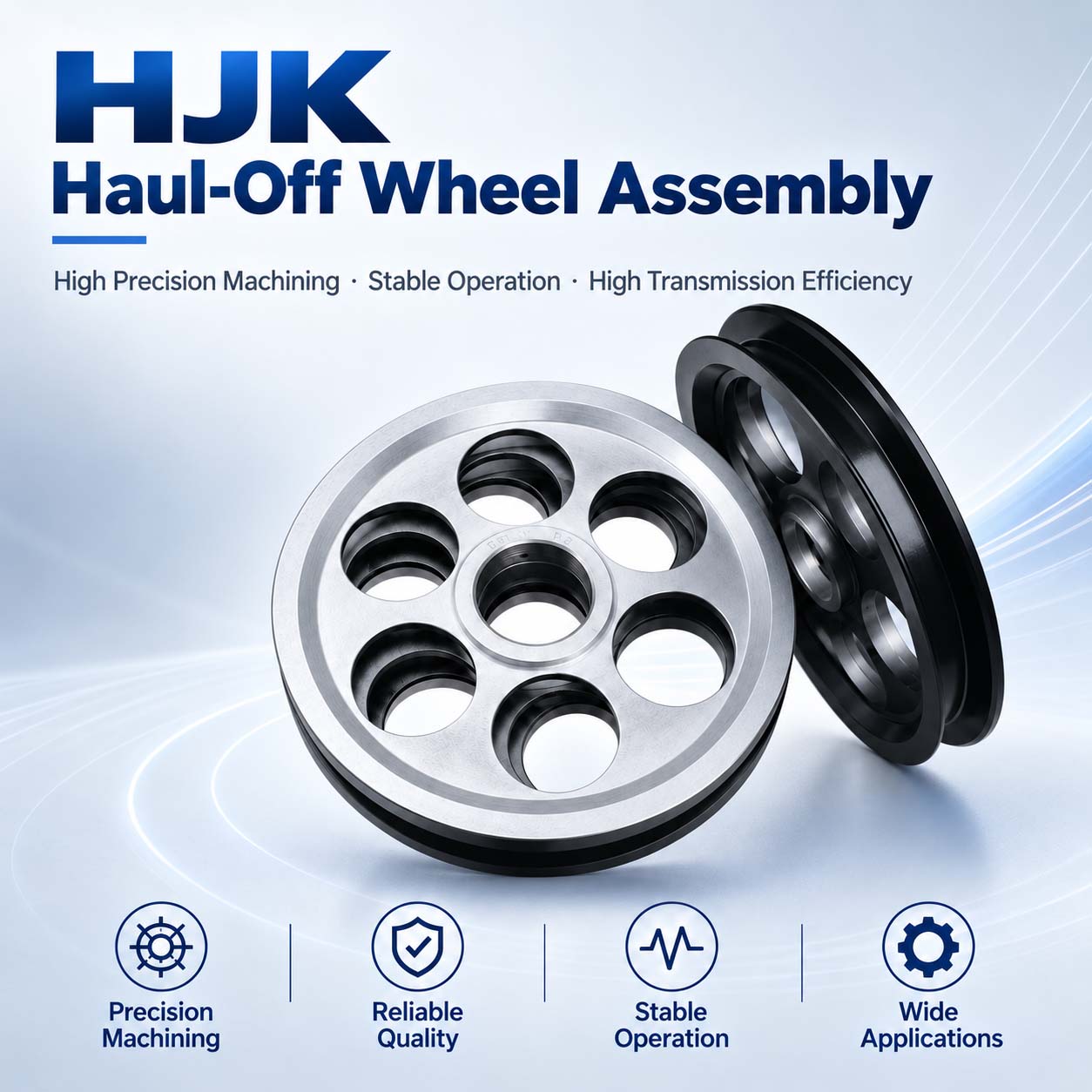
In continuous production lines for wire and cable, fiber optic cable, pipe extrusion, and other industrial applications, stable traction is essential for maintaining consistent product quality. A Haul-Off Wheel Assembly is a key component of the traction system. By combining multiple wheels, it provides stable line speed and controlled tension, helping ensure uniform product diameter and smooth surface quality.
This article introduces the structure, applications, selection considerations, and maintenance of haul-off wheel assemblies.
What Is a Haul-Off Wheel Assembly?
A haul-off wheel assembly usually consists of a drive wheel, driven wheel, and tensioning mechanism. Some systems also include guide wheels or measuring wheels.
The drive wheel is powered by a motor, while friction between the wheel surface and the product generates the pulling force. A multi-wheel configuration increases the wrap angle and improves traction, reducing the risk of slippage.
Common configurations include two-wheel, three-wheel, four-wheel, and multi-wheel systems. The appropriate design depends on the required pulling force, product diameter, and production speed.
Compared with a single haul-off wheel, a multi-wheel assembly provides more stable tension control and is especially suitable for high-speed production, fine wires, optical fibers, and thin-wall tubing.
Common Configurations
Two-Wheel Assembly
A two-wheel system is the simplest configuration, usually consisting of one drive wheel and one driven wheel. The wire or tube passes between or around the two wheels in an S-shaped or U-shaped path.
This design is compact, cost-effective, and suitable for medium- and low-speed production lines.
Three-Wheel and Multi-Wheel Assembly
Three-wheel assemblies provide a larger contact area and stronger traction. They are commonly used in high-speed wire drawing and coated wire production.
Four-wheel, six-wheel, and other multi-wheel systems are suitable for larger extrusion lines where higher pulling force and more accurate tension control are required.
Some designs integrate measuring wheels or encoders for closed-loop speed control.
Assembly with Tensioning Mechanism
Some haul-off wheel assemblies are equipped with spring-loaded or pneumatic tensioning devices.
These mechanisms automatically adjust the distance or pressure between wheels to accommodate different product diameters and compensate for surface wear. This helps maintain consistent contact pressure while reducing marks or deformation on sensitive materials.
Main Applications
Haul-off wheel assemblies are widely used in:
- Wire and Cable Manufacturing: Used after insulation extrusion, sheathing, stranding, and other processes to maintain stable pulling speed and cable diameter.
- Fiber Optic Cable Production: Provides precise, low-tension traction during fiber drawing, coloring, secondary coating, and cable manufacturing.
- Pipe and Tube Extrusion: Used for continuous pulling of plastic pipes, rubber hoses, and other extruded products.
- Metal Wire Processing: Suitable for wire drawing, annealing, coating, plating, and take-up lines.
- Textile and Synthetic Fiber Production: Used for yarn guiding, drawing, and winding processes.
How to Select a Haul-Off Wheel Assembly
Several factors should be considered when selecting the right wheel assembly.
Material and Product Diameter
Different materials such as copper, aluminum, steel, plastic, rubber, and optical fiber have different requirements for wheel hardness, surface roughness, and friction.
Soft or sensitive products require smoother wheel surfaces to avoid scratches and deformation, while harder materials require more wear-resistant wheel surfaces.
Pulling Force and Line Speed
The motor power, wheel diameter, transmission ratio, and bearing system should be selected according to the maximum line speed and required pulling force.
For high-speed applications, good machining accuracy and dynamic balance are particularly important.
Wheel Surface Material
Common wheel materials and surface treatments include:
- Steel: High strength and good wear resistance, suitable for general industrial applications.
- Aluminum Alloy: Lightweight and suitable for high-speed rotation.
- Polyurethane or Rubber: Provides high friction and protects sensitive products from surface damage.
- Ceramic Coating: Offers high hardness, excellent wear resistance, and good surface stability for precision and high-speed applications.
- Tungsten Carbide Coating: Suitable for demanding applications requiring extremely high wear resistance.
The best material should be selected according to production speed, product material, tension, temperature, and service environment.
Installation Design
Haul-off wheel assemblies can be designed in horizontal or vertical configurations.
Quick-change wheel structures are also available for production lines that frequently change product sizes or specifications.
Operating Environment
For high-temperature, humid, dusty, or corrosive environments, the wheel material, coating, bearings, and supporting components should provide adequate resistance to corrosion and wear.
Maintenance and Service
Proper maintenance helps extend the service life of the haul-off wheel assembly and maintain accurate traction.
Regular Cleaning
Remove dust, oil, coating residue, and material deposits from the wheel surface and grooves. Contamination can reduce friction, cause slipping, or scratch the product.
Soft cloth and suitable cleaning agents are recommended. Avoid using sharp or hard tools that may damage the wheel surface.
Check Wheel Wear
Inspect wheel grooves and contact surfaces regularly. Uneven wear may cause product vibration, misalignment, or unstable tension.
If the coating becomes damaged or the base material is exposed, recoating or wheel replacement may be required.
Lubrication and Fastening
Lubricate bearings and tensioning mechanisms according to the equipment maintenance schedule.
Regularly check bolts, shafts, bearing housings, and other fasteners to prevent vibration and positioning errors.
Dynamic Balance
For high-speed wheel assemblies, abnormal vibration may indicate a dynamic balance problem. Rebalancing should be performed when necessary.
Frequently Asked Questions
Why does the haul-off wheel slip?
Common causes include a worn or contaminated wheel surface, insufficient contact pressure, or an inadequate wrap angle.
Clean the wheel surface first and check the tensioning system. If necessary, increase the contact area or use a multi-wheel configuration.
Why are there marks on the wire or tube surface?
Possible causes include excessive pressure, an overly hard wheel surface, damaged grooves, or incorrect wheel alignment.
For sensitive materials, polyurethane, rubber, or specially finished wheel surfaces may provide better protection.
When should the wheel be replaced?
Replacement or refurbishment should be considered when groove wear affects product positioning, the wheel profile is seriously deformed, traction becomes unstable, or the surface coating begins to peel.
Can one wheel assembly handle different product diameters?
Yes. Some assemblies use replaceable wheel rings, interchangeable groove inserts, or adjustable tensioning systems to accommodate different diameters.
The tension and guide wheel positions should be readjusted when changing product specifications.
What are the advantages of ceramic-coated wheels?
Ceramic coatings provide high hardness, excellent wear resistance, smooth surface performance, and good corrosion resistance. They are especially suitable for high-speed production and precision wire or cable applications.
Custom Haul-Off Wheel Assemblies
Haul-off wheel assemblies can be customized according to equipment drawings, product diameter, line speed, pulling force, groove profile, installation dimensions, and operating conditions.
Customized wheel materials, ceramic coatings, tungsten carbide coatings, and other wear-resistant surface treatments are also available to meet the requirements of wire and cable, fiber optic cable, pipe extrusion, metal wire, and other continuous production lines.
