

Coating Service Overview
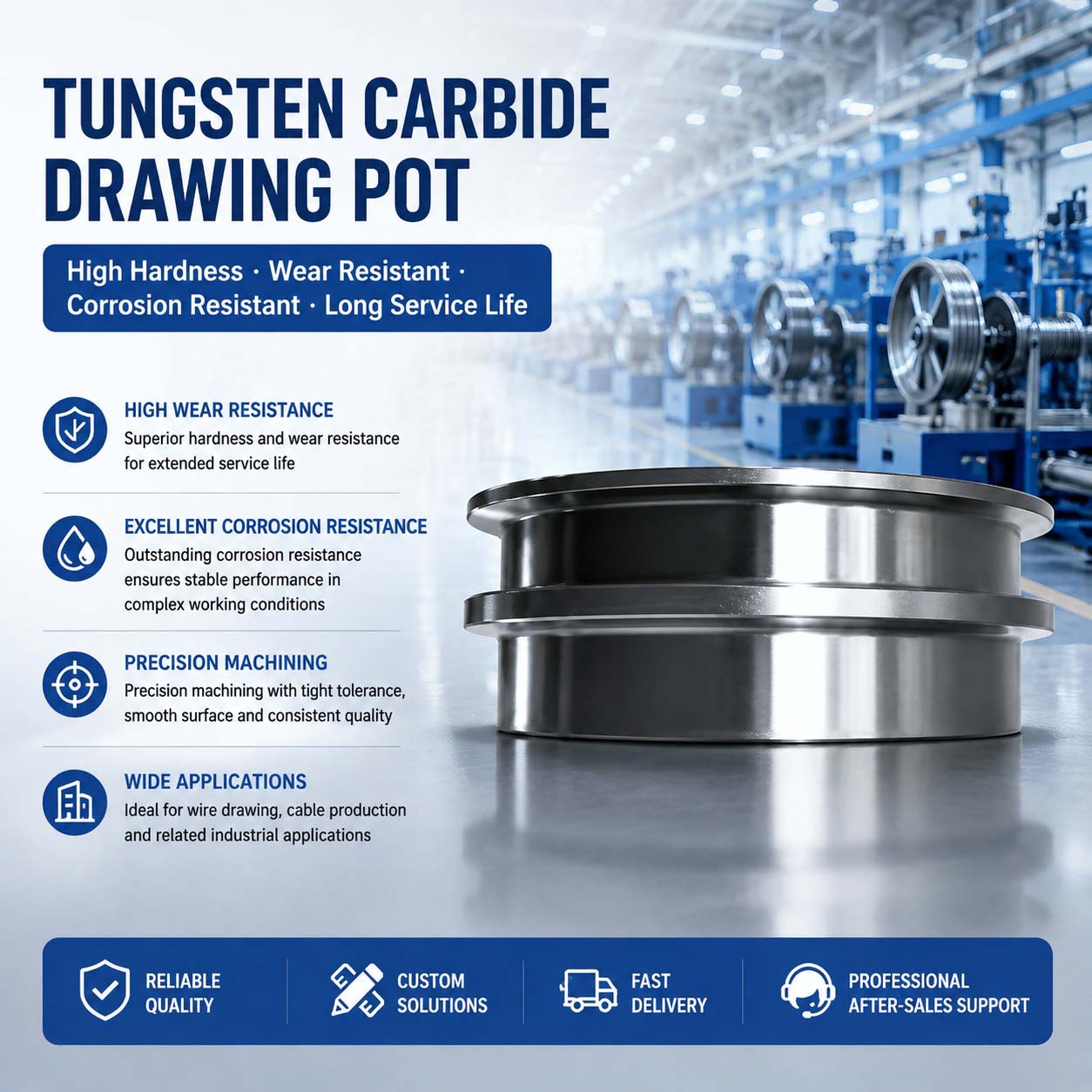
In wire and cable manufacturing, wire drawing is a critical process that determines wire accuracy, surface quality, and production efficiency. The tungsten carbide drawing pot is a key wire-guiding component that directly contacts the wire during the drawing process. It withstands continuous high-speed friction and tension.
Traditional steel drawing pots are prone to wear grooves during long-term operation, causing wire scratches, diameter fluctuations, and frequent production downtime. With much higher hardness and wear resistance than tool steel, tungsten carbide drawing pots provide a reliable solution for improving drawing machine performance and reducing maintenance costs.
Structure and Material Features
A tungsten carbide drawing pot typically consists of a tungsten carbide working layer bonded to a steel base through brazing or shrink fitting.
The working layer is manufactured from fine-grain tungsten carbide powder through a sintering process, providing:
- High hardness (HRA 89 or above)
- Excellent wear resistance
- Long service life
- Stable dimensional accuracy
Compared with hardened tool steel, tungsten carbide offers significantly improved wear performance.
The inner hole is precision ground and polished, with surface roughness controlled as low as:
Ra ≤ 0.2 μm
This ensures:
- Smooth wire passage
- Reduced friction
- Lower risk of surface damage
Some designs include smooth inlet and outlet transition angles to reduce wire bending stress and prevent abnormal wear.
Main Applications
Tungsten carbide drawing pots are widely used for drawing:
- Copper wire
- Aluminum wire
- Alloy wire
- Coated wire
Typical applications include:
- Large, medium, small, and micro wire drawing machines
- Multi-wire drawing machines
- Tension control sections in continuous annealing lines
- Pre-treatment processes before tin plating and silver plating
For high-speed wire drawing applications (above 1000 m/min), tungsten carbide drawing pots maintain stable inner diameter accuracy and help ensure consistent wire quality.
Selection and Installation Guidelines
1. Inner Diameter Matching
The drawing pot inner diameter should match the wire size and production requirements.
A proper clearance is required to:
- Reduce friction heat
- Avoid excessive wire movement
- Maintain surface quality
Incorrect clearance may cause wire vibration, overheating, or surface defects.
2. Installation Accuracy
Proper alignment is essential.
The drawing pot axis should be aligned with:
- Front and rear guide wheels
- Drawing dies
- Machine centerline
Recommended concentricity:
≤ 0.01 mm
Precision alignment helps prevent uneven wear and vibration.
3. Cooling and Lubrication
During operation, sufficient lubricant supply is required.
Proper lubrication helps:
- Reduce friction heat
- Remove metal particles
- Extend tungsten carbide service life
Insufficient cooling may cause thermal stress and micro-cracking of the carbide layer.
Maintenance and Service Life Management
Proper maintenance can significantly extend the service life of tungsten carbide drawing pots.
Recommended practices:
- Inspect the inner hole surface regularly.
- Remove minor deposits or wear marks through professional polishing.
- Measure inner diameter periodically.
- Replace or repair when excessive wear or oval deformation occurs.
- Use special tools during removal to avoid damaging the carbide layer.
- Store spare parts in a dry environment with anti-rust protection.
Worn drawing pots can often be restored through professional processes such as:
- Inner hole re-grinding
- Tungsten carbide layer repair
- Precision polishing
The number of repairs depends on remaining wall thickness and overall condition.
Frequently Asked Questions
What are the advantages of tungsten carbide drawing pots compared with steel drawing pots?
Tungsten carbide drawing pots provide:
- Higher hardness
- Better wear resistance
- Longer service life
- More stable wire surface quality
Their service life can typically be several times longer than traditional steel components.
When should a drawing pot be replaced?
Replacement is recommended when:
- Inner diameter wear exceeds tolerance
- Deep grooves appear
- Wire scratches increase
- Wire diameter becomes unstable
Regular diameter measurement is the most reliable evaluation method.
Can tungsten carbide drawing pots be repaired?
Yes. Minor wear can be repaired through polishing. Severe wear can be restored by tungsten carbide repair and re-grinding, depending on remaining material thickness.
What should be considered during installation?
Ensure:
- Correct alignment
- Clean mounting surfaces
- Proper bolt tightening
- Accurate positioning with guide wheels and dies
What materials are suitable for tungsten carbide drawing pots?
They are widely used for:
- Copper wire
- Aluminum wire
- Copper alloys
- Aluminum alloys
- Various coated wires
They are generally not recommended for extremely hard steel wires containing abrasive particles.
HJK Tungsten Carbide Drawing Pot
HJK provides precision tungsten carbide drawing pots for wire drawing machines, featuring:
- High wear resistance
- Excellent surface finish
- Stable operation
- Long service life
- Customized solutions
Our products help wire and cable manufacturers improve production efficiency, reduce downtime, and achieve consistent high-quality wire processing.
