

Coating Service Overview
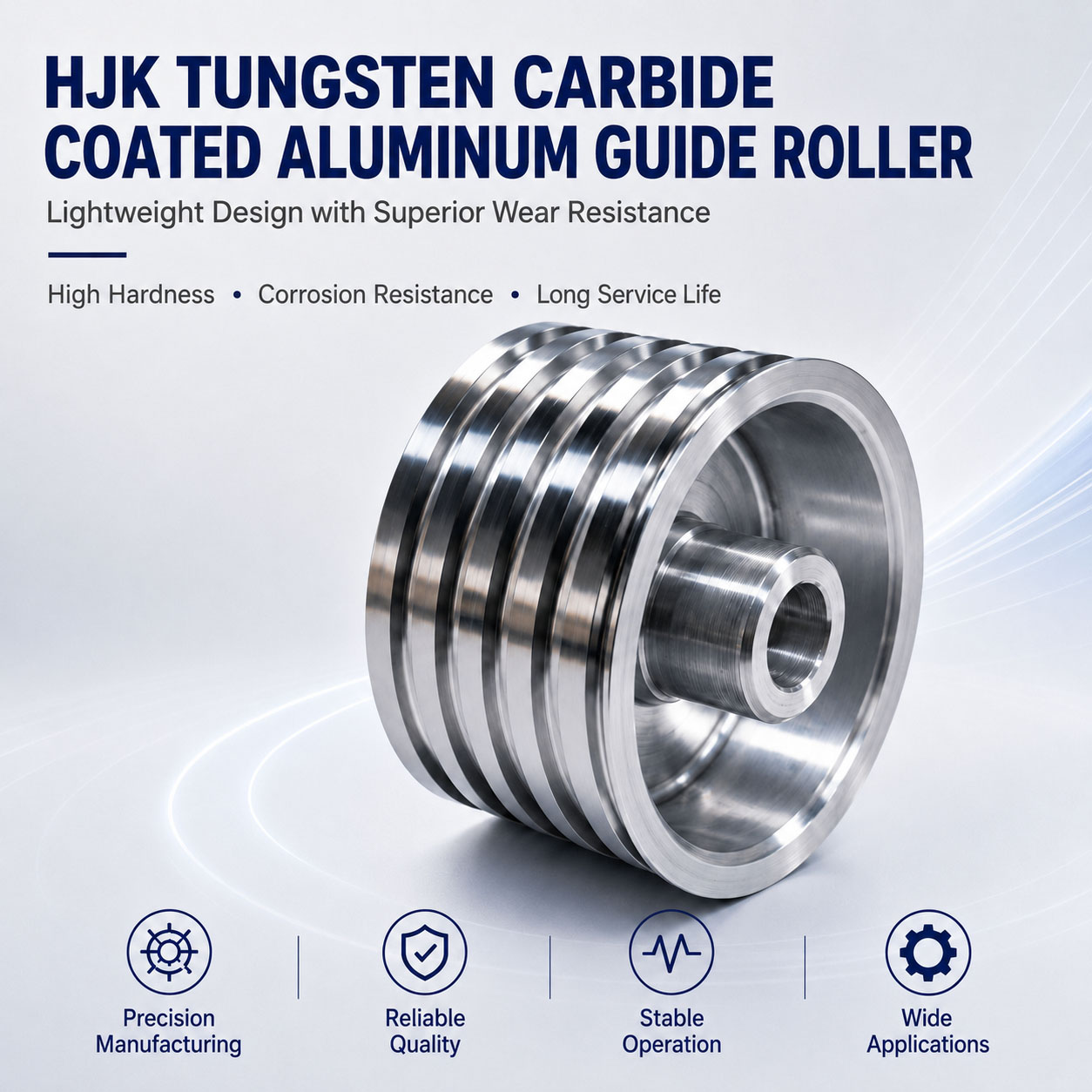
In high-speed wire drawing, textile, and printing industries, the wear resistance of guide rollers directly affects production efficiency and product quality. Aluminum alloy guide rollers offer advantages such as lightweight construction and low rotational inertia, but their low surface hardness makes them vulnerable to wear.
Applying a tungsten carbide coating (thermal sprayed WC coating) to aluminum guide rollers has become a proven solution that combines lightweight design with excellent wear resistance. This article introduces the working principle, applications, selection methods, and maintenance tips of tungsten carbide coated aluminum guide rollers.
What Is Tungsten Carbide Coated Aluminum Guide Roller?
A tungsten carbide coated aluminum guide roller uses an aluminum alloy body (such as 6061 or 7075 aluminum) as the base material. Through advanced thermal spraying processes such as HVOF (High Velocity Oxygen Fuel) spraying or plasma spraying, tungsten carbide (WC) powder is deposited onto the working surface to form a dense, high-hardness wear-resistant coating.
The coating usually contains cobalt (Co) or nickel (Ni) as a binder phase. Typical coating thickness is 0.1–0.3 mm, with hardness reaching HV 1100–1300 and bonding strength exceeding 70 MPa.
Compared with solid carbide rollers, aluminum alloy rollers with tungsten carbide coating maintain lightweight advantages while reducing material costs and allowing easier machining of complex structures. Compared with chrome plating or ceramic coating, tungsten carbide provides better wear resistance, especially under high-speed, high-tension, and abrasive working conditions.
Key Performance Advantages
Excellent Wear Resistance
Tungsten carbide coating provides extremely high hardness and effectively resists abrasive wear and adhesive wear caused by wires, fibers, and other materials. Service life can be several times longer than untreated aluminum rollers.
Lightweight Design
The density of aluminum alloy is approximately one-third that of steel, reducing rotational inertia, improving acceleration performance, and lowering energy consumption during high-speed operation.
Corrosion Resistance
The dense carbide coating protects the aluminum substrate from cooling liquids, lubricants, and humid environments, reducing corrosion-related coating failure.
Repairable Surface
Worn rollers can be restored through coating removal and re-spraying, allowing multiple refurbishments and reducing lifecycle costs.
Main Applications
Wire Drawing Industry
During copper wire, aluminum wire, and alloy wire drawing processes, guide rollers experience continuous friction and tension. Tungsten carbide coated aluminum guide rollers are widely used in fine wire drawing machines, micro wire drawing machines, and multi-head drawing machines.
They help reduce wire scratches, improve surface finish, and maintain stable production quality.
Textile and Fiber Industry
In spinning, texturing, and winding equipment, guide rollers require smooth surfaces, wear resistance, and low damage to fibers. Aluminum alloy rollers with tungsten carbide coating are ideal for high-speed rotation, and the coated surface can be polished to a mirror finish to reduce fiber breakage and defects.
Printing and Packaging Industry
For printing machines, laminating machines, and slitting equipment, tungsten carbide coated rollers provide excellent wear resistance, corrosion protection, and dimensional stability against paper and film friction.
Selection and Customization Guide
When selecting a tungsten carbide coated aluminum guide roller, consider:
- Base Material:
6061-T6 aluminum alloy is commonly used for balanced performance. 7075 aluminum alloy can be selected for higher strength requirements. - Coating Type:
WC-Co is suitable for general wear resistance; WC-Ni provides better corrosion resistance; WC-CrC-Ni is suitable for high-temperature applications. - Dimensions and Accuracy:
Provide roller diameter, width, shaft hole size, and tolerance requirements. After coating, precision grinding can achieve a surface roughness below Ra 0.2 μm. - Dynamic Balance:
For high-speed rollers with line speeds above 30 m/s, dynamic balancing is recommended to reduce vibration and improve service life.
Maintenance Recommendations
- Avoid impact on the coated surface during installation and use proper tools for bearing assembly.
- Ensure sufficient lubrication and cooling to prevent overheating caused by dry friction.
- Keep the roller surface clean and avoid using metal tools that may scratch the coating.
- Regularly inspect coating wear, surface roughness, and roller dimensions. Re-coating is recommended when coating damage or excessive wear occurs.
Frequently Asked Questions
What is the difference between tungsten carbide coating and ceramic coating?
Ceramic coatings such as chromium oxide and aluminum oxide offer high hardness and excellent temperature resistance but are relatively brittle. Tungsten carbide coatings provide better toughness and impact resistance, making them suitable for higher contact stress applications.
Can old aluminum guide rollers be recoated?
Yes. Old rollers can be refurbished after removing the existing coating and checking the substrate condition. Properly restored rollers can achieve performance close to new products at a lower cost.
What wire sizes are suitable for tungsten carbide coated rollers?
They are suitable for various wire drawing applications from conventional wire production to fine and micro wire drawing. Lightweight aluminum construction is especially beneficial for small-diameter wire production by reducing inertia and preventing wire breakage.
When should the roller be refurbished?
Refurbishment is recommended when visible wear grooves appear, surface roughness increases, wire quality decreases, or coating damage exposes the aluminum substrate.
Tungsten carbide coated aluminum guide rollers provide an ideal combination of lightweight design, high wear resistance, and precision performance for modern high-speed industrial applications.
