
Coating Service Overview
In long-term industrial operation, many component failures begin with surface wear, corrosion, oxidation, erosion, or particle impact. Under demanding conditions involving high temperature, corrosive media, heavy dust, and continuous friction, conventional metal surfaces can deteriorate rapidly, resulting in equipment downtime, reduced production efficiency, and higher maintenance costs.
Ceramic thermal spray coating is an advanced surface engineering technology that applies high-performance ceramic materials onto metal substrates. It combines the hardness, heat resistance, corrosion resistance, electrical insulation, and chemical stability of ceramics with the mechanical strength of metallic components.
By adding a functional ceramic layer to the working surface, industrial parts can achieve significantly improved durability and longer service life while reducing replacement and maintenance costs.
What Is Ceramic Thermal Spray Coating?
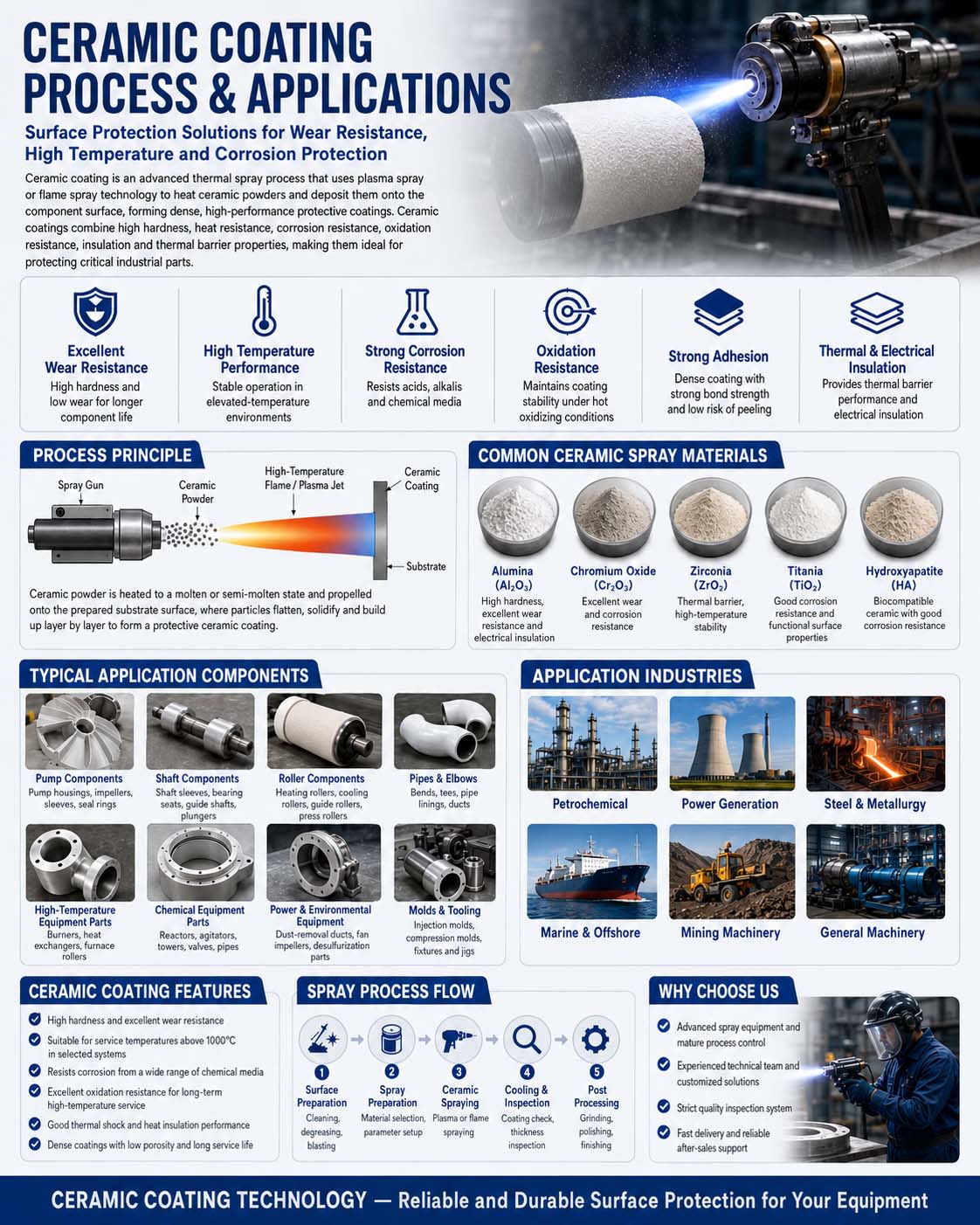
Ceramic spraying is an important branch of thermal spray technology. It typically uses plasma spraying or flame spraying to heat ceramic powders to a molten or semi-molten state and accelerate them toward a properly prepared substrate.
When the heated particles strike the component surface, they flatten, cool, solidify, and build up layer by layer to form a continuous protective coating.
Common ceramic coating materials include:
- Aluminum oxide (Al₂O₃)
- Chromium oxide (Cr₂O₃)
- Zirconium oxide (ZrO₂)
- Titanium oxide (TiO₂)
- Composite ceramic materials
Each material provides different functional properties.
Alumina coatings offer excellent hardness, wear resistance, and electrical insulation.
Chromium oxide coatings provide outstanding resistance to wear and corrosion.
Zirconia coatings are widely used for high-temperature insulation and thermal barrier applications.
Titanium oxide coatings provide corrosion resistance and functional surface properties.
The main engineering concept is simple: the metal substrate provides structural strength, while the ceramic coating protects the surface from wear, heat, corrosion, oxidation, or electrical exposure.
Main Advantages of Ceramic Coatings
1. Excellent Wear Resistance
Ceramic materials have high hardness and excellent resistance to friction and abrasive particles.
Ceramic coatings are commonly applied to:
- Industrial rollers
- Bushings
- Guide wheels
- Seal rings
- Pump components
- Valve parts
They help reduce surface wear, dimensional change, excessive clearance, and premature sealing failure.
For components operating under continuous sliding, rolling, or particle erosion, ceramic coatings can significantly extend maintenance intervals.
2. High-Temperature Resistance
Many industrial ceramics remain stable at elevated temperatures.
Ceramic thermal spray coatings are therefore suitable for:
- Industrial furnaces
- Boiler components
- Kiln rollers
- High-temperature ducts
- Heating equipment
- Thermal processing systems
The coating separates the metallic substrate from direct exposure to high-temperature gases or materials, helping reduce oxidation, thermal degradation, and heat-related damage.
3. Strong Corrosion Resistance
Ceramic coatings provide excellent chemical stability and resistance to many aggressive industrial environments.
Depending on the ceramic material, coatings can help protect components against:
- Acids
- Alkalis
- Salt spray
- Chemical gases
- Moisture
- Corrosive process media
This makes ceramic spraying suitable for chemical processing equipment, marine systems, flue gas treatment equipment, and industrial pollution control systems.
4. Electrical Insulation
Ceramic materials such as alumina offer excellent electrical insulation.
Typical applications include:
- Electrical equipment components
- Insulating rollers
- Sensor protection parts
- Semiconductor equipment
- Electrical isolation components
Ceramic coatings can provide both electrical insulation and protection against electrochemical corrosion.
5. Oxidation Resistance and Thermal Insulation
Ceramic coatings can form a protective barrier between the metal substrate and the external environment.
For high-temperature applications, zirconia coatings are especially valuable because of their low thermal conductivity.
They are widely used as thermal barrier coatings to reduce heat transfer to the substrate and improve component reliability.
6. Suitable for New Parts and Component Repair
Ceramic spraying can be used both for new component enhancement and worn-part restoration.
For new parts, the coating improves surface performance before installation.
For used parts, it can restore damaged surfaces and improve wear, corrosion, or thermal resistance, allowing valuable components to be reused instead of replaced.
Common Ceramic Spray Materials
Aluminum Oxide Coating
Alumina is one of the most widely used ceramic thermal spray materials.
Key properties include:
- High hardness
- Excellent wear resistance
- Electrical insulation
- Good thermal stability
Typical applications include:
- Insulating rollers
- Bushings
- Seal components
- Guide wheels
- Pump and valve parts
Alumina is particularly suitable when both wear resistance and electrical insulation are required.
Chromium Oxide Coating
Chromium oxide provides excellent resistance to both wear and corrosion.
It is commonly used for:
- Pump sleeves
- Plungers
- Seal rings
- Valve components
- Paper industry rollers
Chromium oxide performs particularly well in environments where moisture, corrosion, and mechanical wear occur simultaneously.
Zirconia Coating
Zirconia provides excellent high-temperature resistance and thermal insulation.
Typical applications include:
- Aerospace components
- Combustion equipment
- Heat-treatment furnaces
- High-temperature piping
- Thermal barrier systems
Zirconia coatings help reduce heat transfer and protect metallic substrates from extreme temperatures.
Titanium Oxide Coating
Titanium oxide coatings provide useful corrosion resistance and functional surface properties.
They can be used in special applications requiring:
- Corrosion protection
- Wear resistance
- Anti-stick performance
- Functional surface modification
Composite Ceramic Coatings
Composite materials such as alumina-titania or multilayer ceramic systems can combine several performance advantages.
They can be engineered to improve:
- Wear resistance
- Corrosion resistance
- Thermal stability
- Coating toughness
- Bonding performance
Composite coatings are often selected for demanding applications where a single ceramic material cannot provide all required properties.
Industrial Applications of Ceramic Thermal Spray Coatings
Petrochemical Industry
Pumps, sleeves, seal rings, valves, and piping components are frequently exposed to chemicals, solvents, acids, alkalis, and corrosive gases.
Ceramic coatings provide a protective barrier that improves chemical stability and reduces substrate corrosion.
Power Generation and Energy
Ceramic coatings are widely used on:
- Boiler components
- Fan parts
- Flue gas ducts
- Desulfurization equipment
- Denitrification equipment
- Electrical insulation components
They provide heat resistance, corrosion protection, and insulation in demanding energy applications.
Steel and Metallurgy
Steel production equipment is exposed to high temperatures, oxide scale, dust, and aggressive process environments.
Ceramic coatings can protect:
- Furnace rollers
- Heat-treatment tooling
- Pickling equipment
- Galvanizing line components
- Guide components
The coatings help reduce oxidation, surface wear, and material adhesion.
Mining Equipment
Mining equipment is frequently exposed to slurry, sand, and abrasive particles.
Typical ceramic coating applications include:
- Slurry pumps
- Pump sleeves
- Pipe surfaces
- Guide components
- Wear surfaces
The coating improves resistance to wet abrasion and corrosion-assisted wear.
Cement and Building Materials
Equipment in cement and building material plants operates under heavy dust and high-temperature conditions.
Ceramic coatings are used on:
- Kiln rollers
- Conveyor rollers
- Fan components
- Powder handling systems
- Process equipment
They improve wear resistance and thermal durability.
General Machinery
Ceramic coatings can be customized for a wide variety of industrial components, including:
- Pumps
- Valves
- Rollers
- Bushings
- Seals
- Guide wheels
- Heating rollers
- Insulating rollers
The coating system is selected according to whether the main requirement is wear resistance, corrosion resistance, high-temperature protection, electrical insulation, or anti-stick performance.
Aerospace and Advanced Equipment
Ceramic thermal barrier and oxidation-resistant coatings are widely used in advanced high-temperature systems.
Typical applications include:
- Engine hot-section components
- Turbine components
- High-temperature structural parts
- Thermal protection systems
These coatings improve thermal durability and reliability in demanding service conditions.
Ceramic Thermal Spray Process
陶瓷热喷涂工艺
A typical ceramic coating process includes:
Application Analysis → Surface Preparation → Ceramic Spraying → Post-Treatment → Quality Inspection
Surface Preparation
The component is cleaned, degreased, and grit blasted to remove contaminants and create an appropriate surface profile.
Proper preparation is critical for coating adhesion.
Spray Application
The ceramic powder is heated and sprayed onto the substrate.
Important process parameters include:
- Spray distance
- Heat input
- Powder feed rate
- Particle size
- Coating thickness
- Component temperature
Precise control ensures uniform coating structure and consistent performance.
Post-Treatment
Depending on application requirements, ceramic coatings may undergo:
- Precision grinding
- Polishing
- Sealing treatment
- Dimensional finishing
Quality Inspection
Typical inspection items include:
- Coating appearance
- Thickness
- Surface roughness
- Hardness
- Bonding quality
Critical industrial parts may require additional performance testing.
Ceramic Coating vs Other Surface Treatments
Compared with conventional painting or anti-rust coatings, ceramic spraying provides functional surface protection rather than simple corrosion prevention.
Compared with electroplating, ceramic coatings offer a wider material range and are better suited to high-temperature and electrical insulation applications.
Compared with welding overlays, ceramic thermal spraying has lower heat input and causes less component deformation, making it suitable for precision components.
However, ceramic materials are relatively brittle. For components exposed to severe mechanical impact, the coating structure, bond coat, thickness, and operating conditions must be carefully evaluated.
How to Choose a Ceramic Coating Supplier
A reliable ceramic thermal spray supplier should provide more than spraying equipment.
Important capabilities include:
- Professional plasma spray equipment
- Ceramic material selection expertise
- Customized coating design
- Precision grinding and machining
- Quality inspection capability
Because ceramic materials have high melting points and demanding processing requirements, coating quality depends heavily on equipment, parameter control, substrate preparation, and post-processing.
An integrated supplier can provide better control over final dimensions, coating thickness, surface roughness, and functional performance.
Frequently Asked Questions
What substrate materials can be ceramic coated?
Ceramic thermal spraying is suitable for many metal substrates, including carbon steel, stainless steel, alloy steel, aluminum, and titanium.
The coating system should be designed according to substrate properties, thermal expansion behavior, and operating conditions.
What temperatures can ceramic coatings withstand?
The temperature capability depends on the ceramic material and coating system.
Alumina coatings are commonly used in elevated-temperature applications, while zirconia coatings are widely selected for much higher-temperature thermal barrier applications.
Actual service temperature should always be determined according to coating structure and operating conditions.
Can ceramic coatings be machined after spraying?
Yes.
Because ceramic coatings are very hard, precision grinding is normally performed using diamond grinding tools.
Polishing can also be used when a smoother surface finish is required.
Can ceramic coatings peel off?
Properly applied ceramic coatings provide strong adhesion and reliable service performance.
However, poor surface preparation, improper coating thickness, excessive thermal stress, or severe mechanical impact may cause coating failure.
Professional coating design is therefore important.
How should I choose between alumina, chromium oxide, and zirconia?
For primarily wear-resistant applications, alumina is a common choice.
For combined wear and corrosion resistance, chromium oxide is often more suitable.
For high-temperature insulation and thermal barrier applications, zirconia is generally preferred.
For complex operating conditions, composite or multilayer coating systems may be recommended.
What is the typical ceramic coating thickness?
Ceramic thermal spray coatings are commonly applied in thicknesses of approximately 0.1 mm to 1 mm, depending on the application.
The optimum thickness should balance protection performance, mechanical reliability, and finishing requirements.
Conclusion
Ceramic thermal spray coating is an effective surface engineering solution for industrial components operating under wear, heat, corrosion, oxidation, and electrical exposure.
By combining a strong metallic substrate with a functional ceramic surface layer, ceramic spraying can significantly improve component performance, extend service life, reduce maintenance frequency, and lower replacement costs.
From petrochemical and power generation equipment to steel production, mining machinery, aerospace, and advanced manufacturing, ceramic coatings provide reliable protection for demanding industrial applications.