
Coating Service Overview
In modern industries, many equipment failures do not occur because of insufficient structural strength, but because surface damage develops first. Wear, corrosion, erosion, and abrasion are common causes of component failure.
Industries such as oil and gas, power generation, mining, metallurgy, and general machinery often operate under extreme conditions involving high temperature, heavy loads, friction, and abrasive particles. Conventional metal surfaces may not provide sufficient protection under these demanding environments.
HVOF thermal spray coating (High Velocity Oxygen Fuel spraying) is an advanced surface engineering technology that creates dense, low-porosity, high-bond-strength coatings on metal components.
By applying materials such as tungsten carbide, chromium carbide, nickel alloys, and metal ceramics, HVOF coatings significantly improve wear resistance, corrosion protection, erosion resistance, and component service life.
This technology is widely used for surface strengthening, dimensional restoration, and industrial component remanufacturing.
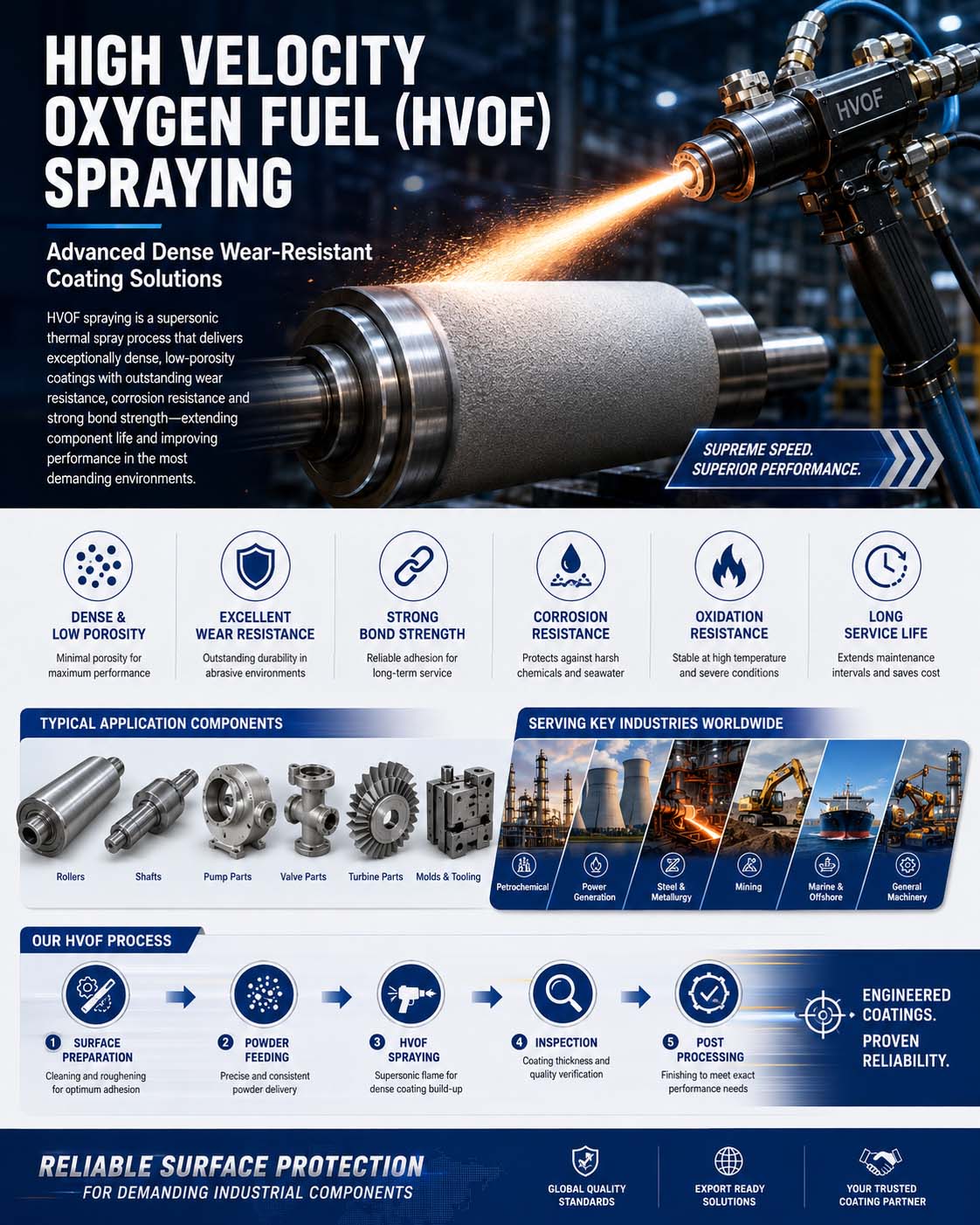
What Is HVOF Thermal Spray Coating?
什么是 HVOF 热喷涂?
HVOF spraying is an advanced thermal spray process that uses combustion fuel and oxygen inside a spray gun to generate an extremely high-speed flame.
The coating powder is heated to a molten or semi-molten state and accelerated at high velocity toward a prepared substrate surface. Upon impact, the particles deform, flatten, and bond together to form a dense protective coating.
Compared with traditional flame spraying and arc spraying, HVOF technology provides:
- Higher particle velocity
- Lower coating porosity
- Stronger bonding strength
- Better coating density
- Reduced oxidation
It is especially suitable for materials such as:
- Tungsten carbide (WC-Co, WC-CoCr)
- Chromium carbide
- Nickel-based alloys
- Metal ceramic composites
These coatings provide excellent performance in applications requiring wear resistance, corrosion protection, and erosion resistance.
Key Advantages of HVOF Coatings
HVOF 涂层的主要优势
1. High Bonding Strength
During HVOF spraying, coating particles impact the substrate at extremely high speed, creating strong mechanical bonding.
With proper:
- Surface cleaning
- Grit blasting
- Preheating
- Process control
the coating achieves excellent adhesion and reliability.
It is suitable for:
- High-speed rotating components
- Heavy-load equipment
- Severe friction applications
- Particle erosion environments
2. Dense Structure and Low Porosity
HVOF coatings have a compact microstructure with low porosity.
This dense structure helps prevent:
- Corrosive media penetration
- Particle intrusion
- Surface degradation
It is widely applied to:
- Pump shafts
- Valve sealing surfaces
- Rollers
- Fan components
- Hydraulic parts
3. Excellent Wear Resistance
Tungsten carbide HVOF coatings provide extremely high hardness and wear resistance.
They effectively protect components against:
- Sliding wear
- Abrasive wear
- Particle erosion
- Surface scratching
Typical applications include:
- Shafts
- Sleeves
- Rollers
- Guide wheels
- Pump components
- Seal rings
4. Superior Erosion and Abrasion Resistance
Industrial equipment in mining, power, steel, and oil industries is often exposed to:
- Sand particles
- Dust
- Slurry
- Ash
- High-speed material flow
HVOF coatings reduce surface erosion and help maintain component dimensions and performance.
5. Low Thermal Impact and Minimal Deformation
Compared with welding overlays, HVOF spraying introduces much less heat into the substrate.
Advantages include:
- Reduced thermal distortion
- Better dimensional stability
- Suitable for precision components
It is widely used for:
- Shafts
- Rollers
- Valves
- Thin-wall components
After spraying, precision grinding and polishing can achieve required surface accuracy.
6. New Component Enhancement and Repair
HVOF coating is not only used for new component protection but also for repair and remanufacturing.
Through coating deposition and precision machining, worn components can be restored and upgraded.
Benefits include:
- Reduced replacement costs
- Shorter downtime
- Extended equipment life
Common HVOF Coating Materials
Tungsten Carbide Coating
Tungsten carbide is the most widely used HVOF coating material.
Common types include:
- WC-Co
- WC-CoCr
Advantages:
- Extremely high hardness
- Excellent wear resistance
- Strong erosion resistance
Typical applications:
- Pump shafts
- Sleeves
- Plungers
- Hydraulic rods
- Valve balls
- Valve seats
- Rollers
- Guide wheels
- Fan blades
Chromium Carbide Coating
Chromium carbide performs well in high-temperature wear environments.
Advantages:
- High-temperature resistance
- Oxidation resistance
- Good wear protection
Applications include:
- Steel production equipment
- Heat treatment components
- Boiler systems
- High-temperature fans
Nickel-Based Alloy Coating
Nickel alloy coatings provide:
- Corrosion resistance
- Oxidation resistance
- Thermal stability
They are suitable for:
- Chemical equipment
- Pumps and valves
- Marine components
- Gas treatment systems
Metal Ceramic Composite Coatings
Metal ceramic coatings combine:
- Ceramic hardness
- Metal toughness
They are suitable for complex environments involving:
- Wear
- Corrosion
- Temperature changes
- Impact loads
Industrial Applications of HVOF Coatings
Oil and Gas Industry
Oil and gas equipment often operates under:
- High pressure
- Sand erosion
- Corrosive conditions
Applications include:
- Valve sealing surfaces
- Choke valves
- Pump sleeves
- Plungers
- Drill components
Tungsten carbide coatings improve erosion resistance and extend service intervals.
Power Generation Industry
Power equipment is exposed to dust, ash, and high-temperature conditions.
Applications include:
- Fan blades
- Pump components
- Valve surfaces
- Wear-resistant pipes
HVOF coatings reduce maintenance frequency and improve equipment reliability.
Mining Industry
Mining machinery suffers from severe abrasion caused by minerals and particles.
Applications include:
- Crusher components
- Conveyor rollers
- Slurry pumps
- Sleeves
- Guide parts
Tungsten carbide coatings improve hardness and wear resistance.
Steel and Metallurgy Industry
Steel manufacturing involves:
- High temperatures
- Oxide scale
- Abrasive particles
Applications include:
- Continuous casting rollers
- Guide rollers
- Conveyor rollers
- Valve components
- Fan blades
HVOF coatings improve surface durability and production stability.
General Machinery Industry
Common applications include:
- Pumps
- Valves
- Compressors
- Rollers
- Hydraulic rods
- Shafts
- Sleeves
HVOF repair coating restores dimensions and improves surface performance.
Aerospace and Advanced Equipment
High-performance coatings are used for:
- Hydraulic components
- Landing gear parts
- Valve systems
- Precision mechanical components
They provide improved:
- Wear resistance
- Anti-scuff performance
- Service reliability
HVOF Coating Process
A complete HVOF coating process usually includes:
1. Component Inspection and Solution Design
Engineers analyze:
- Operating conditions
- Wear mechanism
- Temperature
- Required coating thickness
Suitable coating materials are selected according to application requirements.
2. Surface Preparation
The component undergoes:
- Cleaning
- Degreasing
- Sand blasting
- Surface roughening
Proper preparation is essential for strong coating adhesion.
3. HVOF Spraying
During spraying, parameters are carefully controlled:
- Spray distance
- Powder feed rate
- Flame conditions
- Particle velocity
- Coating thickness
This ensures uniform and stable coating quality.
4. Finishing and Inspection
After spraying, components may require:
- Grinding
- Polishing
- Precision machining
Quality inspection includes:
- Coating thickness
- Hardness
- Bond strength
- Surface condition
Advantages Compared with Traditional Repair Methods
Compared with Welding Repair
HVOF provides:
- Lower heat input
- Less deformation
- Better precision
Compared with Conventional Spraying
HVOF offers:
- Higher density
- Stronger bonding
- Better wear resistance
Compared with Component Replacement
HVOF repair can:
- Reduce costs
- Shorten downtime
- Extend component life
- Support remanufacturing
How to Choose an HVOF Coating Supplier
When selecting a coating provider, consider:
Advanced HVOF Equipment
Professional equipment ensures stable coating quality.
Engineering Experience
A qualified supplier should recommend suitable materials based on:
- Wear type
- Temperature
- Corrosion conditions
- Mechanical loads
Machining Capability
Because HVOF coatings often require grinding and finishing, integrated machining capability improves delivery accuracy.
Quality Control
Professional inspection should include:
- Thickness measurement
- Hardness testing
- Bond strength testing
- Microstructure analysis
Frequently Asked Questions
How thick can HVOF coatings be?
The coating thickness depends on the material and application requirements.
Typical thickness ranges from:
0.1 mm to several millimeters
The final design depends on wear allowance and machining requirements.
Is tungsten carbide coating suitable for high temperatures?
Tungsten carbide is mainly suitable for medium-temperature wear applications.
For higher temperatures, chromium carbide or nickel-based alloys may be more appropriate.
Does the coated part require machining?
Yes. Most HVOF-coated components require grinding or polishing to achieve:
- Precise dimensions
- Required surface roughness
Can HVOF coating repair worn shafts?
Yes.
HVOF spraying can restore worn shaft surfaces and improve wear resistance through coating buildup and precision machining.
How is coating quality evaluated?
Quality can be evaluated through:
- Thickness measurement
- Hardness testing
- Bond strength testing
- Metallographic analysis
Professional suppliers provide inspection reports to ensure reliability.
What is the difference between HVOF and plasma spraying?
HVOF provides:
- Higher particle velocity
- Denser coatings
- Stronger bonding
It is especially suitable for tungsten carbide coatings.
Plasma spraying provides:
- Higher temperatures
and is more suitable for high-melting-point ceramic materials.
Conclusion
HVOF thermal spray coating is an advanced surface protection technology designed for industrial components exposed to severe wear, corrosion, erosion, and demanding operating conditions.
With high density, strong adhesion, excellent wear resistance, and low thermal impact, HVOF coatings provide reliable solutions for oil and gas, mining, power generation, metallurgy, aerospace, and general machinery industries.
By extending component life, reducing maintenance costs, and improving equipment reliability, HVOF coating technology has become a key solution in modern industrial surface engineering.