
Coating Service Overview
In modern industries, many critical components fail due to surface damage caused by wear, corrosion, erosion, and friction.
Industries such as oil and gas, power generation, mining, steel manufacturing, cement, and paper production often operate equipment under extreme conditions involving heavy loads, high-speed friction, abrasive particles, and corrosive environments. Traditional metal surfaces may quickly lose performance under these conditions.
Tungsten carbide coating technology is an advanced thermal spray surface treatment process that applies a high-hardness tungsten carbide layer onto component surfaces. The coating significantly improves resistance to wear, erosion, and abrasion while extending equipment service life and reducing maintenance costs.
With excellent hardness, bonding strength, and durability, tungsten carbide coatings have become an important solution for industrial surface protection and remanufacturing.
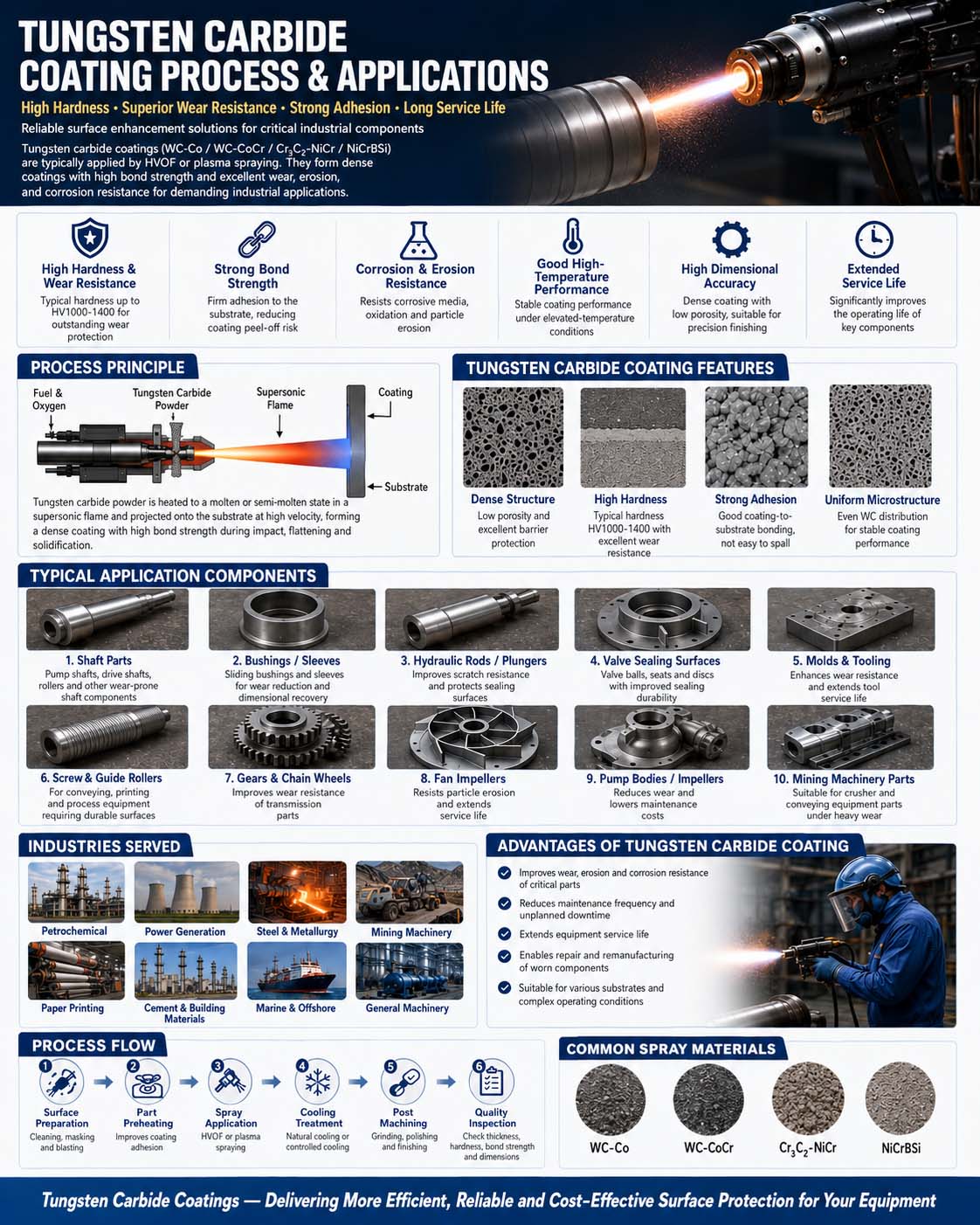
What Is Tungsten Carbide Thermal Spray Coating?
什么是碳化钨热喷涂?
Tungsten carbide thermal spray coating is a surface engineering process that uses thermal spraying technology to deposit tungsten carbide-based powder onto component surfaces, creating a highly wear-resistant protective layer.
The most common technologies include:
- High Velocity Oxygen Fuel Spraying (HVOF)
- Plasma Spraying
Among them, HVOF is widely used because it produces dense coatings with excellent hardness, low porosity, and strong adhesion.
Common tungsten carbide coating materials include:
- WC-Co
- WC-CoCr
- WC-Ni
- WC-NiCr
The suitable coating material is selected according to:
- Wear type
- Corrosion environment
- Operating temperature
- Mechanical load
Key Advantages of Tungsten Carbide Coatings
1. Extremely High Hardness and Wear Resistance
Tungsten carbide is one of the hardest engineering materials available.
The coating effectively resists:
- Sliding wear
- Abrasive wear
- Particle erosion
- Surface scratching
It is widely used for components such as:
- Shafts
- Pump parts
- Hydraulic rods
- Rollers
- Valve sealing surfaces
By reducing surface damage, tungsten carbide coatings help maintain dimensional accuracy and improve equipment reliability.
2. Strong Bonding Strength and Excellent Durability
Before spraying, components undergo professional surface preparation, including:
- Cleaning
- Degreasing
- Sand blasting
- Surface roughening
During HVOF spraying, high-speed particles impact the substrate surface and form a dense coating structure with strong adhesion.
This makes tungsten carbide coatings suitable for:
- High-speed rotating parts
- Heavy-load equipment
- Impact and friction environments
3. Excellent Resistance to Erosion
Many industrial components are damaged by high-speed particles such as:
- Sand
- Mineral powder
- Dust
- Ash
- Slurry particles
Tungsten carbide coatings provide excellent erosion resistance and are widely applied to:
- Fan blades
- Pump sleeves
- Valve surfaces
- Pipeline components
- Mining equipment
4. Dense Protective Structure
Tungsten carbide coatings feature:
- Low porosity
- High density
- Stable surface protection
They help reduce penetration of corrosive media and improve component performance in environments involving both wear and corrosion.
Typical applications include:
- Chemical equipment
- Oil and gas machinery
- Marine equipment
- Pumps and valves
5. Component Repair and Remanufacturing
Many expensive components are discarded only because of surface wear.
Tungsten carbide spraying can rebuild worn surfaces and restore dimensions through:
- Coating deposition
- Grinding
- Precision machining
Common repair applications include:
- Pump shafts
- Drive shafts
- Bearing seats
- Hydraulic rods
- Rollers
- Sealing surfaces
This provides an economical alternative to replacing entire components.
Tungsten Carbide Thermal Spray Process
1. Working Condition Analysis
Before coating, engineers evaluate:
- Wear mechanism
- Operating temperature
- Load conditions
- Chemical environment
- Required coating thickness
Based on this information, the appropriate tungsten carbide material and process parameters are selected.
2. Surface Preparation
Proper preparation is essential for coating performance.
The process normally includes:
- Cleaning
- Oil removal
- Rust removal
- Sand blasting
- Surface protection
A properly prepared surface improves coating adhesion and prevents premature failure.
3. HVOF Spraying Process
During HVOF spraying:
- Tungsten carbide powder is heated and accelerated at high velocity.
- Particles impact the substrate surface.
- A dense and strong coating layer is formed.
Important parameters include:
- Spray distance
- Powder feeding rate
- Flame condition
- Particle velocity
- Surface temperature
Professional control ensures stable coating quality.
4. Finishing and Machining
Because tungsten carbide coatings have very high hardness, post-processing is usually required.
Typical processes include:
- Grinding
- Polishing
- Precision machining
This ensures:
- Accurate dimensions
- Proper surface roughness
- Reliable assembly performance
5. Quality Inspection
Coating quality is evaluated through:
- Visual inspection
- Thickness measurement
- Hardness testing
- Bond strength testing
- Porosity analysis
- Surface roughness measurement
Typical Applications of Tungsten Carbide Coatings
Shafts and Rotating Components
Applications include:
- Pump shafts
- Drive shafts
- Motor shafts
- Rotor shafts
- Bearing positions
The coating restores worn surfaces and improves wear resistance.
Hydraulic Rods and Plungers
Hydraulic components often suffer from:
- Scratches
- Friction wear
- Seal damage
Tungsten carbide coatings improve surface durability and extend hydraulic system life.
Valve Components
Used for:
- Valve seats
- Valve balls
- Valve cores
- Gate valves
The coating improves resistance against:
- High pressure
- Particle erosion
- Leakage caused by wear
Pumps and Fluid Equipment
Applications include:
- Pump shafts
- Sleeves
- Seal rings
- Impellers
The coating reduces damage caused by fluid erosion and friction.
Rollers and Guide Wheels
Used for:
- Conveyor rollers
- Guide rollers
- Traction rollers
- Industrial wheels
Tungsten carbide coatings improve surface wear resistance and maintain production quality.
Fan Blades and Impellers
In industries such as:
- Power generation
- Steel
- Cement
- Mining
fan components are exposed to continuous particle erosion.
Tungsten carbide coatings reduce blade wear and improve operating stability.
Industrial Applications
Oil and Gas Industry
Used for:
- Drilling tools
- Valve sealing surfaces
- Pump sleeves
- Throttle valves
- Drill pipe components
Provides excellent wear and erosion protection in harsh environments.
Power Generation Industry
Applications include:
- Fan blades
- Ash handling equipment
- Pump components
- Valve systems
Improves reliability and reduces maintenance frequency.
Mining Industry
Used for:
- Crushers
- Slurry pumps
- Conveyor components
- Wear parts
Enhances resistance to abrasive materials.
Steel and Metallurgy Industry
Applications include:
- Continuous casting rollers
- Guide rollers
- Conveyor rollers
- Hydraulic components
Protects components under high-load and abrasive conditions.
Cement and Building Materials Industry
Equipment exposed to large amounts of dust and particles benefits from tungsten carbide protection.
Applications include:
- Conveyor rollers
- Fan blades
- Powder handling equipment
- Mixing components
Paper, Printing, and Packaging Industry
Used for:
- Rollers
- Guide rolls
- Coating rolls
- Traction rollers
Improves roller durability and maintains surface quality.
Tungsten Carbide Coating vs Other Surface Treatments
Compared with Surface Hardening
Advantages:
- Higher wear resistance
- More flexible material selection
- Suitable for precision repair
Compared with Welding Repair
Advantages:
- Lower heat input
- Less deformation
- Better for precision components
Compared with Traditional Protective Coatings
Advantages:
- Higher hardness
- Better mechanical protection
- Suitable for heavy-duty operating conditions
How to Choose a Tungsten Carbide Coating Supplier
When selecting a coating supplier, consider:
Advanced HVOF Equipment
Professional equipment directly affects coating density and performance.
Engineering Experience
A reliable supplier should provide customized solutions based on:
- Component design
- Operating conditions
- Wear mechanism
Machining Capability
Since tungsten carbide coatings require precision finishing, integrated machining capability ensures final accuracy.
Quality Control System
Important inspection capabilities include:
- Coating thickness testing
- Bond strength testing
- Hardness testing
- Surface finish inspection
Frequently Asked Questions
What is the typical thickness of tungsten carbide coating?
The coating thickness is usually between:
0.1 mm and 0.5 mm
The final thickness depends on wear allowance and application requirements.
Can tungsten carbide coating repair worn shafts?
Yes. Tungsten carbide spraying is commonly used for repairing:
- Pump shafts
- Drive shafts
- Bearing surfaces
It restores dimensions while improving wear resistance.
What are the advantages of tungsten carbide coating compared with hard chrome plating?
Tungsten carbide coatings generally provide:
- Higher hardness
- Better wear resistance
- Stronger erosion resistance
The best choice depends on operating conditions and cost requirements.
What surface finish can tungsten carbide coatings achieve?
After grinding and polishing, coatings can achieve high precision finishes suitable for sealing and mechanical applications.
How high a temperature can tungsten carbide coating withstand?
Tungsten carbide coatings perform well in moderate temperature environments. For continuous high-temperature applications, alternative materials such as ceramic coatings may be considered.
Conclusion
Tungsten carbide thermal spray coating is an advanced surface strengthening technology designed for industrial components exposed to severe wear, erosion, and friction.
With outstanding hardness, durability, and protection performance, WC-Co coatings provide reliable solutions for oil and gas, mining, power, metallurgy, manufacturing, and heavy industrial applications.
By extending component life, reducing downtime, and lowering maintenance costs, tungsten carbide coating technology has become a valuable solution for modern industrial equipment protection and remanufacturing.