
Coating Service Overview
Under extreme operating conditions involving high temperature, severe wear, and corrosive environments, industrial components face significant challenges in service life and reliability.
Zirconia (ZrO₂) coating technology is an advanced ceramic surface enhancement solution that applies zirconia powder onto component surfaces through thermal spraying processes, creating a high-performance protective coating.
With excellent thermal stability, low thermal conductivity, high hardness, corrosion resistance, and wear resistance, zirconia coatings effectively improve equipment durability and operating reliability.
This article introduces the working principle, major coating technologies, performance advantages, applications, and key process considerations of zirconia thermal spray coatings.
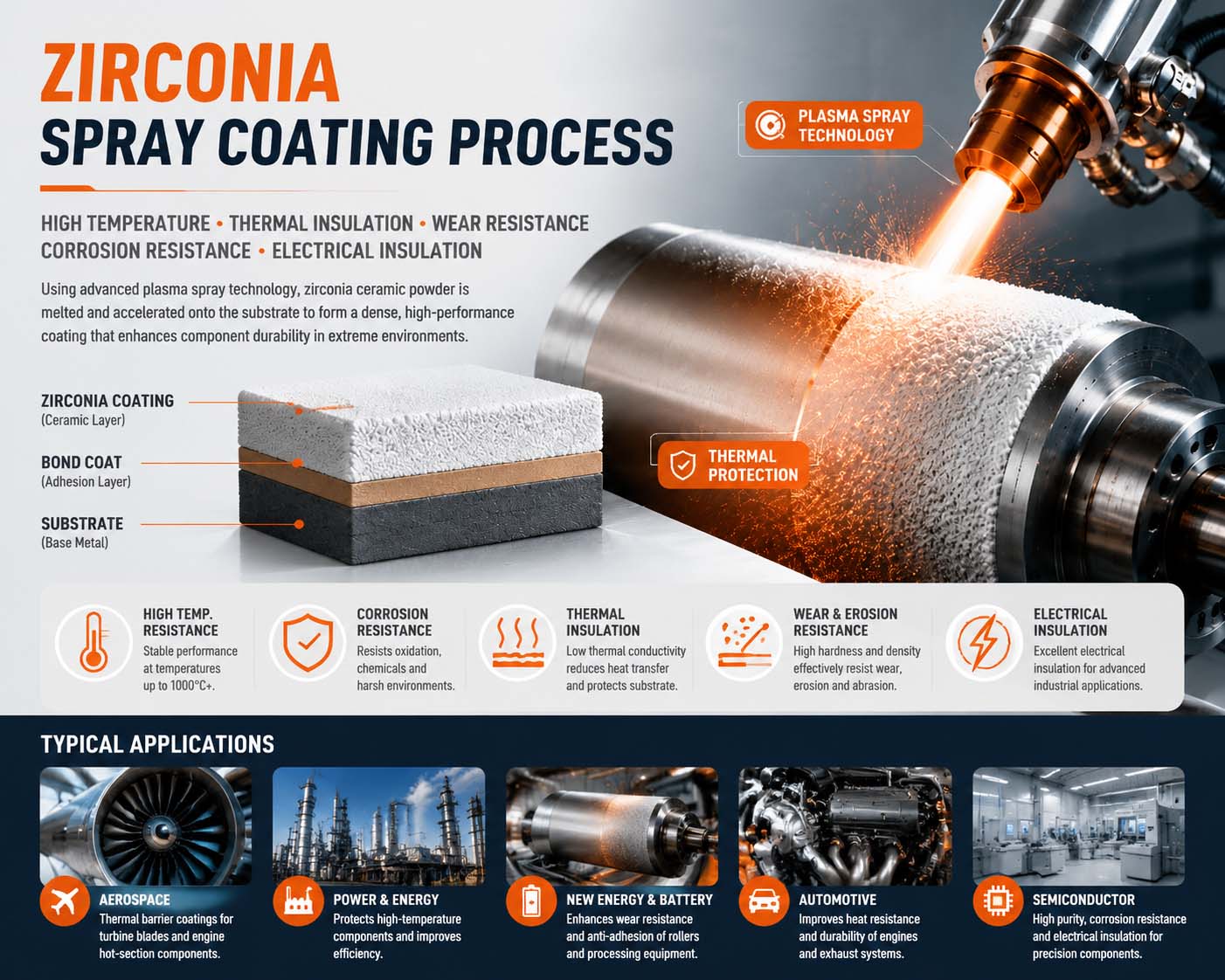
Working Principle of Zirconia Thermal Spray Coating
Zirconia coating is mainly produced using advanced thermal spray technologies such as:
- Atmospheric Plasma Spraying (APS)
- High Velocity Oxygen Fuel Spraying (HVOF)
During the spraying process, zirconia ceramic powder is heated into a molten or semi-molten state by a high-temperature heat source. The particles are accelerated toward a pretreated substrate surface, where they impact, deform, spread, cool, and solidify layer by layer, forming a dense ceramic coating.
The typical process flow includes:
Component Inspection → Surface Cleaning → Sand Blasting → Preheating → Zirconia Spraying → Coating Inspection → Precision Finishing
By optimizing spraying parameters, zirconia coatings can achieve strong adhesion, stable structure, and excellent long-term performance.
Main Zirconia Spraying Technologies
Atmospheric Plasma Spraying (APS)
APS is the most widely used method for producing zirconia thermal barrier coatings.
The process uses a plasma arc to generate an extremely high-temperature and high-speed jet, melting zirconia powder and depositing it onto the component surface.
Key advantages:
- Extremely high spraying temperature
- Suitable for ceramic materials
- Excellent thermal insulation performance
- Suitable for large and complex components
Typical applications include:
- Aircraft engine thermal barrier coatings
- Gas turbine blades
- High-temperature furnace components
- Industrial heating equipment
High Velocity Oxygen Fuel Spraying (HVOF)
HVOF uses high-speed combustion flames to accelerate coating particles toward the substrate.
The resulting coatings feature:
- High density
- Low porosity
- Excellent wear resistance
- Superior surface quality
HVOF zirconia coatings are suitable for:
- Precision mechanical components
- High-temperature wear parts
- Special wear-resistant surfaces
APS vs HVOF Selection
For applications requiring:
High-temperature protection and thermal insulation → APS is preferred
High density and wear resistance → HVOF is more suitable
The final selection should consider component structure, operating conditions, and cost requirements.
Key Performance Advantages of Zirconia Coatings
Excellent High-Temperature Resistance
Zirconia has an extremely high melting point and maintains structural stability under high-temperature conditions.
It effectively protects metal substrates from thermal damage and is widely used in:
- Engine hot-section components
- Industrial furnaces
- Combustion systems
Superior Thermal Barrier Performance
Zirconia is a ceramic material with low thermal conductivity.
As a thermal barrier coating (TBC), it reduces heat transfer and protects the underlying metal components from extreme temperatures.
This improves:
- Equipment reliability
- Operating efficiency
- Component lifespan
Excellent Corrosion Resistance
Zirconia offers outstanding chemical stability and resistance against:
- Oxidation
- Molten metal corrosion
- Chemical media
- Harsh industrial environments
It is suitable for long-term protection in demanding applications.
High Hardness and Wear Resistance
Zirconia ceramic coatings provide excellent resistance against:
- Friction wear
- Particle erosion
- Surface scratching
They are widely used for mechanical components requiring enhanced durability.
Excellent Electrical Insulation
As an advanced ceramic material, zirconia provides good electrical insulation properties.
It is commonly used in:
- Semiconductor equipment
- Precision electronic systems
- Electrical insulation components
Applications of Zirconia Thermal Spray Coatings
Aerospace Industry
Zirconia thermal barrier coatings are a key technology in aircraft engines.
They help:
- Reduce thermal loads
- Protect high-temperature components
- Improve engine efficiency and reliability
Typical applications include:
- Turbine blades
- Combustion chamber components
- Hot-section engine parts
New Energy and Battery Manufacturing
Zirconia coatings are used in:
- Battery production rollers
- Thermal processing equipment
- High-temperature tooling
- Anti-stick components
They improve equipment stability and reduce maintenance frequency.
Automotive Industry
Applications include:
- Engine components
- Exhaust system parts
- High-temperature friction components
Zirconia coatings enhance heat resistance and service durability.
Semiconductor Industry
Due to their:
- High purity
- Plasma corrosion resistance
- Electrical insulation properties
zirconia coatings protect precision semiconductor equipment components.
Industrial Furnaces and Energy Equipment
Zirconia coatings help:
- Reduce heat loss
- Improve energy efficiency
- Extend equipment operating life
They are widely used in high-temperature industrial environments.
Key Process Considerations
Substrate Preparation
Proper surface preparation is critical for coating adhesion.
Typical procedures include:
- Oil and contaminant removal
- Oxide scale cleaning
- Sand blasting
- Surface roughening
A suitable surface profile ensures strong bonding between zirconia coating and substrate.
Spraying Parameter Control
Coating performance depends on:
- Spray distance
- Powder particle size
- Flame temperature
- Spraying speed
- Coating thickness
Professional parameter optimization ensures stable coating quality.
Post-Coating Finishing
Depending on application requirements, additional processing may include:
- Precision grinding
- Polishing
- Dimensional restoration
- Surface inspection
These processes ensure the coating meets industrial precision requirements.
Frequently Asked Questions
What temperature can zirconia coatings withstand?
Zirconia has a very high melting point and can typically withstand continuous high-temperature environments above 800°C.
The actual temperature capability depends on:
- Coating structure
- Stabilizing materials
- Operating conditions
What are the advantages of zirconia spraying compared with electroplating?
Zirconia thermal spray coatings provide:
- High-temperature resistance
- Thermal insulation
- Electrical insulation
- Ceramic surface protection
Electroplated coatings are mainly metallic and generally have more limited temperature resistance and functional performance.
What is the typical thickness of zirconia coatings?
Depending on application requirements, zirconia coatings are typically:
0.1 mm to 1 mm thick
Thermal barrier coatings may require greater thickness, controlled through optimized spraying parameters.
How do I choose between APS and HVOF zirconia coating?
Choose APS when the primary requirement is:
- Thermal insulation
- High-temperature protection
Choose HVOF when the priority is:
- High coating density
- Wear resistance
- Surface durability
The final choice depends on operating conditions and component requirements.
Can zirconia coatings peel off?
With proper:
- Surface preparation
- Material selection
- Spraying parameters
zirconia coatings provide strong adhesion and reliable service performance.
However, improper processing or operation beyond design conditions may cause coating failure.
Is sealing treatment required after spraying?
For applications requiring higher corrosion resistance or insulation performance, sealing treatment can be applied to reduce coating porosity and further improve protection.
The need depends on the specific working environment.
Conclusion
Zirconia thermal spray coating is an advanced surface engineering technology designed for industrial components exposed to extreme heat, wear, and corrosion.
With outstanding thermal barrier performance, wear resistance, chemical stability, and electrical insulation properties, zirconia coatings provide reliable protection for aerospace, energy, automotive, semiconductor, and industrial manufacturing applications.
For companies seeking longer component life, reduced maintenance costs, and improved equipment reliability, zirconia coating technology offers an efficient and sustainable surface protection solution.