
Coating Service Overview
Plasma Spray is an advanced thermal spray coating technology that uses a high-temperature plasma arc to generate a high-speed thermal jet. Metal, ceramic, alloy, and composite powders are heated to a molten or semi-molten state and accelerated onto the surface of a component, forming a high-performance functional coating.
Due to its extremely high spraying temperature, wide material compatibility, and excellent coating properties, plasma spraying has become an important surface engineering technology for modern industrial equipment.
The process can significantly improve component performance, including:
- Wear resistance
- Corrosion resistance
- High-temperature resistance
- Oxidation resistance
- Thermal insulation
- Electrical insulation
- Erosion resistance
Plasma spraying is widely used in aerospace, energy, automotive, metallurgy, semiconductor, and advanced manufacturing industries to improve equipment reliability and extend service life.
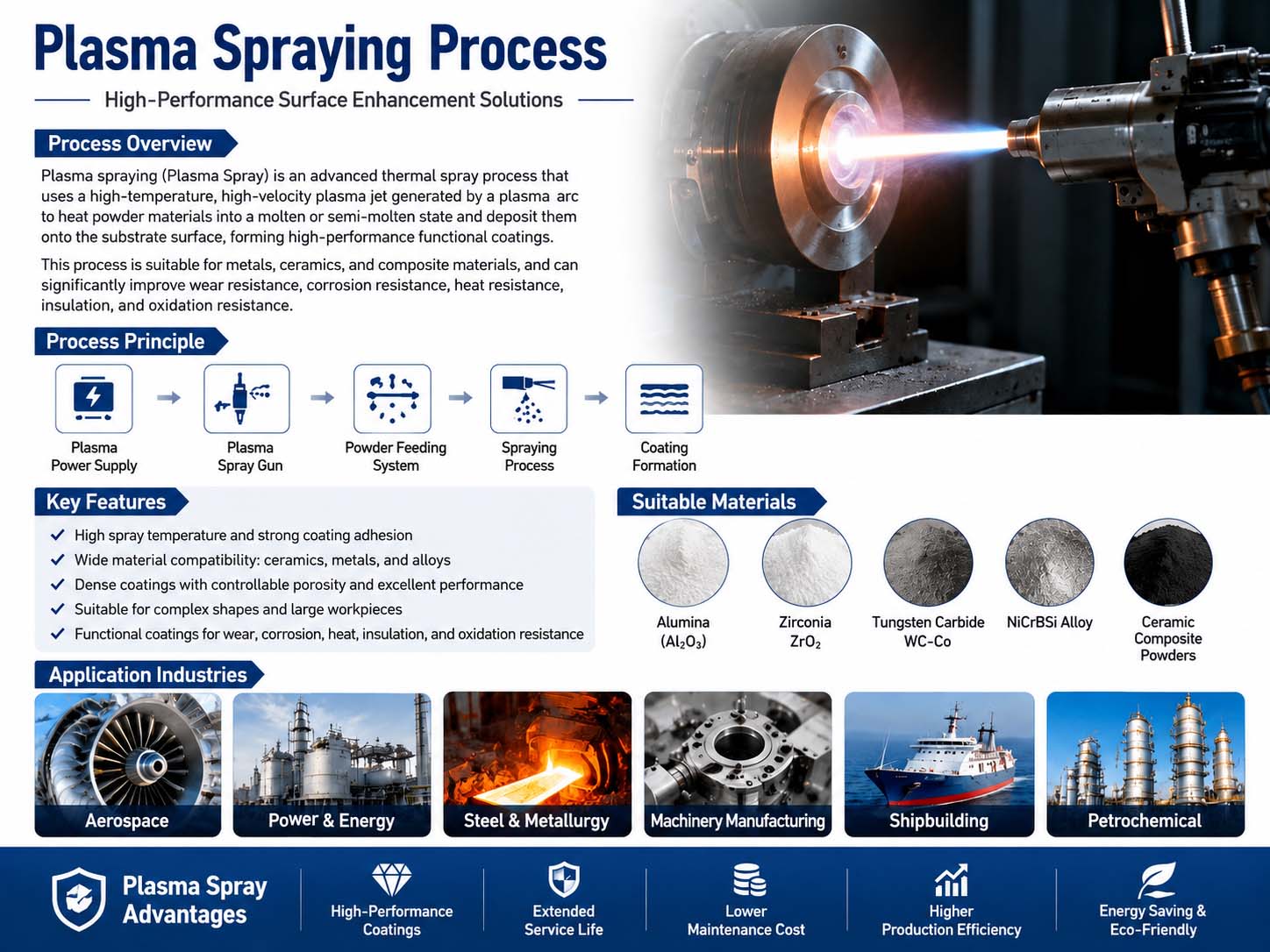
Working Principle of Plasma Spraying
等离子喷涂的工作原理
Plasma spraying uses a plasma arc as the heat source. During operation, an electric arc ionizes working gases such as argon, hydrogen, or nitrogen, creating an extremely high-temperature plasma flame.
The spraying process includes the following steps:
1. Generation of High-Temperature Plasma Jet
The plasma power system produces an arc discharge, generating a high-energy plasma stream with temperatures reaching thousands of degrees Celsius.
2. Powder Melting and Heating
Metal, ceramic, or alloy powders are injected into the plasma flame and rapidly heated into molten or semi-molten particles.
3. High-Speed Deposition and Coating Formation
The heated particles impact the substrate surface at high velocity, deform, spread, cool, and solidify layer by layer, forming a dense protective coating.
4. Post-Treatment and Finishing
According to application requirements, the coated components may undergo:
- Grinding
- Polishing
- Precision machining
- Dimensional restoration
- Performance inspection
to achieve the required surface quality and accuracy.
Plasma Spraying Process
1. Surface Preparation
Proper surface preparation is essential for coating quality and bonding strength.
Typical preparation procedures include:
- Degreasing and cleaning
- Sand blasting
- Surface roughening
- Preheating treatment
These processes improve the adhesion between the coating and the substrate.
2. Plasma Spray Application
The coating material and process parameters are selected according to the working environment.
Important parameters include:
- Spray distance
- Current and voltage
- Powder particle size
- Powder feeding rate
- Coating thickness
Precise control ensures stable coating performance and long-term reliability.
3. Coating Inspection
After spraying, coating quality is evaluated through:
- Coating thickness measurement
- Bond strength testing
- Hardness testing
- Porosity analysis
- Metallographic examination
This ensures the coating meets industrial performance requirements.
Materials Used in Plasma Spraying
Ceramic Materials
Aluminum Oxide (Al₂O₃)
Alumina coatings provide:
- High hardness
- Excellent wear resistance
- Electrical insulation
They are widely used for wear-resistant and insulating components.
Zirconia (ZrO₂)
Zirconia features:
- Low thermal conductivity
- Excellent thermal stability
- High-temperature resistance
It is one of the most important materials for thermal barrier coatings in high-temperature applications.
Chromium Oxide (Cr₂O₃)
Chromium oxide coatings offer:
- Excellent wear resistance
- Good corrosion resistance
- High surface hardness
Metal and Alloy Materials
Common metal-based materials include:
- Nickel-based alloys
- Cobalt-based alloys
- Iron-based alloys
- Stainless steel
- Aluminum alloys
- Copper alloys
These materials are mainly used for:
- Corrosion protection
- Wear resistance
- Surface restoration
- Dimensional repair
Composite Materials
Examples include:
- Tungsten carbide (WC-Co)
- Metal-ceramic composites
- Advanced functional ceramic powders
These coatings are designed for extreme environments involving severe wear, impact, and high temperatures.
Advantages of Plasma Spraying Technology
High-Temperature Processing Capability
The plasma flame provides extremely high thermal energy, allowing the spraying of materials with high melting points, including advanced ceramics and heat-resistant alloys.
Wide Material Compatibility
Compared with conventional spraying methods, plasma spraying supports a wider range of coating materials, enabling customized surface solutions for different applications.
Excellent Coating Performance
Plasma sprayed coatings can provide:
- High hardness
- Superior wear resistance
- Corrosion protection
- High-temperature resistance
- Oxidation protection
- Thermal barrier properties
- Electrical insulation
Suitable for Complex Components
Plasma spraying can be applied to:
- Large industrial equipment
- Precision components
- Complex geometries
- Curved surfaces
- Special alloy parts
making it suitable for various manufacturing requirements.
Applications of Plasma Spraying
Aerospace Industry
Plasma spraying is widely used for:
- Turbine blades
- Combustion chamber components
- High-temperature engine parts
Thermal barrier coatings help reduce heat exposure and improve engine reliability.
New Energy and Battery Industry
Applications include:
- Battery production rollers
- Thermal processing components
- Precision tooling equipment
Plasma coatings improve wear resistance, corrosion protection, and equipment stability.
Automotive Manufacturing
Used for:
- Engine components
- Exhaust system parts
- Friction and wear components
Plasma coatings help improve durability and operating performance.
Steel and Metallurgy Industry
For harsh environments involving high temperature and abrasion, plasma spraying protects:
- Continuous casting equipment
- Industrial rollers
- Guide wheels
- Heat-resistant components
Power Generation Industry
Applied to:
- Gas turbines
- Boiler components
- Energy equipment
to improve heat resistance and oxidation protection.
Plasma Spraying for Industrial Equipment Upgrade
With the development of intelligent manufacturing and advanced industrial equipment, components are facing increasingly demanding operating conditions, including extreme temperatures, heavy wear, and corrosive environments.
Traditional materials often cannot meet these challenges. Plasma spraying provides an effective solution by adding high-performance protective coatings onto component surfaces.
Benefits include:
- Extended equipment service life
- Reduced maintenance costs
- Lower replacement frequency
- Improved production efficiency
- Enhanced equipment reliability
As a key surface engineering technology, plasma spraying plays an important role in modern industrial upgrading and remanufacturing.
Frequently Asked Questions
What is the difference between plasma spraying and flame spraying?
Plasma spraying uses a plasma arc as the heat source, providing much higher temperatures than flame spraying. It can process high-melting-point materials such as ceramics and produces coatings with higher density and bonding strength.
What coating thickness can plasma spraying achieve?
The coating thickness typically ranges from 0.05 mm to several millimeters, depending on application requirements and process parameters.
What materials can be plasma sprayed?
Plasma spraying can be applied to various substrates, including:
- Metals
- Alloys
- Ceramics
- Composite materials
Proper surface preparation is required to ensure strong coating adhesion.
Does plasma spraying require post-processing?
In many applications, grinding or polishing is required to achieve precise dimensions and surface finish. The specific process depends on the final application requirements.
How do you select plasma spray materials?
Material selection depends on:
- Operating temperature
- Wear conditions
- Corrosive environment
- Mechanical requirements
The appropriate coating material should be selected according to actual service conditions.
How long does a plasma spray coating last?
The service life depends on operating conditions, coating material, spraying parameters, and post-processing quality. Proper coating design and professional application can significantly extend component lifespan.
Conclusion
Plasma spraying is a high-performance surface engineering technology that provides advanced protection for industrial components exposed to wear, corrosion, heat, and erosion.
With excellent material flexibility, superior coating performance, and wide industrial applications, plasma spraying has become a reliable solution for equipment protection, surface enhancement, and industrial remanufacturing.
For companies seeking improved durability, reduced maintenance costs, and higher equipment efficiency, plasma spray coating technology offers an effective and sustainable solution.