
Coating Service Overview
In industrial production, mechanical components are constantly exposed to harsh operating conditions such as high temperature, friction, impact, abrasion, and corrosion. Over time, critical parts may suffer from surface wear, scratches, dimensional deviation, corrosion damage, and performance degradation.
The failure of key components can lead to unexpected downtime, reduced production efficiency, and increased maintenance costs. Instead of replacing expensive parts, spray welding repair technology provides an efficient surface restoration and strengthening solution.
By applying alloy materials onto worn surfaces and forming a strong metallurgical bond with the substrate, spray welding can restore component dimensions, improve surface performance, and significantly extend service life.
Compared with traditional replacement methods, spray welding repair reduces maintenance costs, shortens downtime, and improves equipment reliability. It has become an important technology in modern industrial maintenance and remanufacturing.
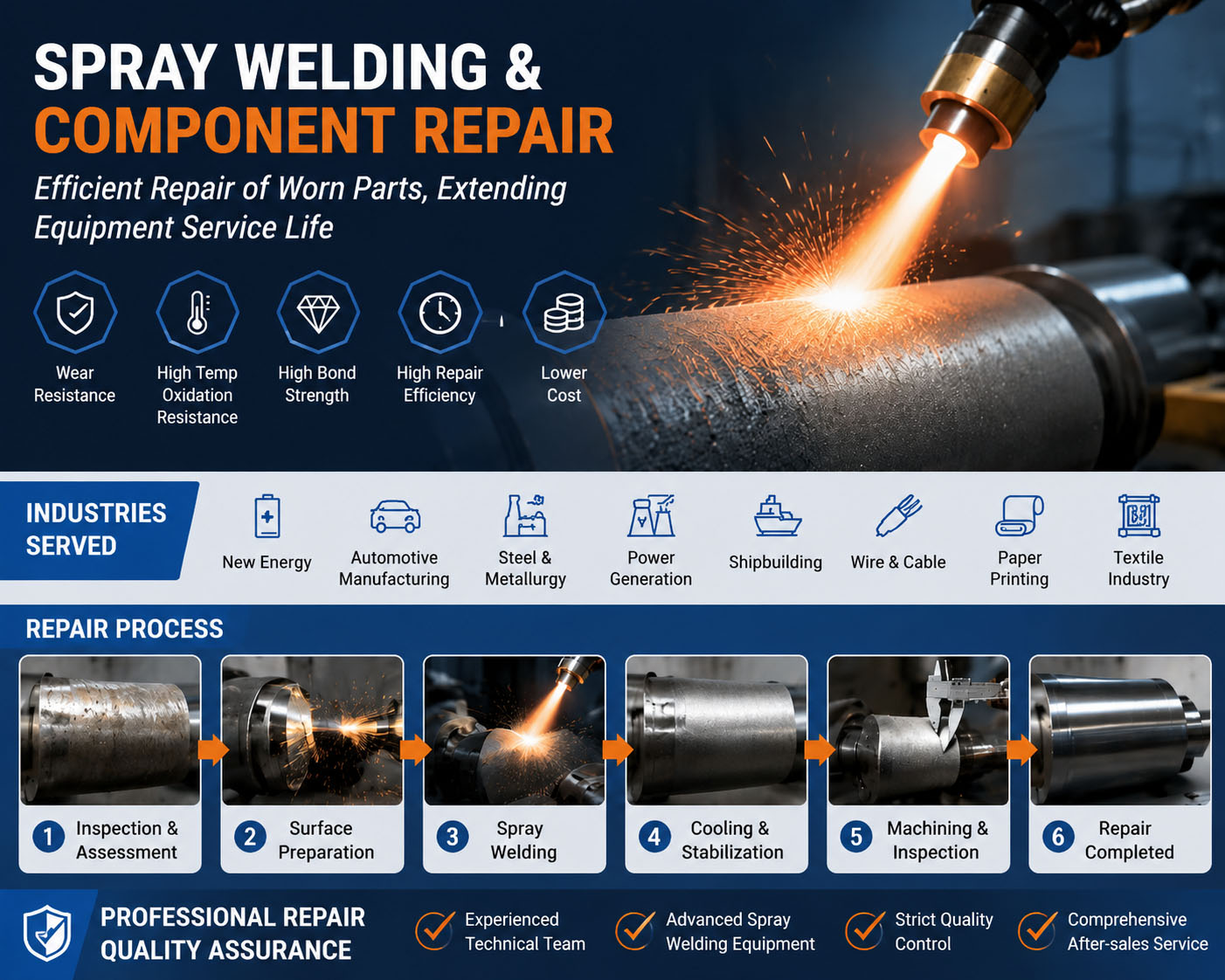
What Is Spray Welding Technology?
什么是喷涂焊接技术?
Spray welding is an advanced surface engineering process that combines thermal spraying and fusion technology.
During the process, alloy powder or wire materials are sprayed onto the surface of a workpiece using a heat source. The coating is then heated to a molten state, allowing it to fuse with the base material and form a dense protective layer with excellent mechanical properties.
The basic spray welding process includes:
1. Surface Preparation
The damaged surface is cleaned, degreased, and roughened through machining or blasting to improve coating adhesion.
2. Alloy Material Spraying
Specialized spray welding equipment applies alloy powder or wire evenly onto the component surface.
3. Fusion and Metallurgical Bonding
The sprayed layer is reheated and melted, creating a strong metallurgical connection between the coating and the substrate.
4. Cooling and Finishing
After cooling, the repaired component is machined, ground, or polished to achieve the required dimensions and surface quality.
The final spray welded layer provides excellent wear resistance, corrosion resistance, impact resistance, and high-temperature performance, making it suitable for demanding industrial applications.
The Role of Spray Welding in Component Repair
喷焊在零部件修复中的作用
Modern industrial repair is not only about restoring damaged dimensions but also improving the original performance of components.
Spray welding repair can achieve:
- Restoration of worn dimensions
- Repair of scratches, grooves, and corrosion damage
- Improvement of wear resistance
- Enhancement of corrosion protection
- Improvement of high-temperature oxidation resistance
- Extension of component service life
- Reduction of replacement and maintenance costs
For large machinery, imported equipment, and high-value components, spray welding repair provides significant economic benefits.
Spray Welding Repair Process
1. Inspection and Damage Analysis
Before repair, engineers evaluate:
- Wear condition
- Corrosion level
- Cracks and defects
- Dimensional deviation
- Operating environment
Based on these factors, the appropriate repair method, coating thickness, and alloy material are selected.
2. Surface Preparation
Proper surface preparation is essential for coating quality.
Typical procedures include:
- Oil and grease removal
- Rust removal
- Surface cleaning
- Damaged layer removal by machining
- Sand blasting for surface roughening
A properly prepared surface ensures strong bonding between the spray welded layer and the base metal.
3. Preheating Treatment
For large components or special materials, preheating may be required.
Preheating helps:
- Reduce thermal stress
- Prevent cracking
- Improve coating quality
- Enhance bonding performance
4. Spray Welding Application
According to the working environment and component material, suitable alloy materials are selected.
Common spray welding materials include:
- Nickel-based alloys
- Cobalt-based alloys
- Iron-based alloys
- Tungsten carbide composites
- Self-fluxing alloy powders
These materials provide different advantages in wear resistance, corrosion resistance, and high-temperature protection.
5. Cooling and Final Machining
After spray welding, components are cooled under controlled conditions.
Depending on precision requirements, further processes may include:
- Turning
- Grinding
- Polishing
- Dimensional correction
- Quality inspection
The repaired component is finally restored to meet assembly and operation requirements.
Advantages of Spray Welding Repair Technology
High Bonding Strength
Unlike ordinary coatings that mainly rely on mechanical adhesion, spray welding creates a metallurgical bond between coating and substrate.
This provides:
- Strong adhesion
- Excellent durability
- Resistance to coating peeling
Excellent Wear Resistance
Spray welded coatings can withstand:
- Sliding wear
- Abrasive wear
- Impact wear
- Particle erosion
They are widely used for repairing high-wear industrial components.
Superior Corrosion Protection
By selecting corrosion-resistant alloys such as nickel-based and cobalt-based materials, repaired parts can achieve excellent protection against:
- Chemical corrosion
- Moisture corrosion
- Salt spray environments
- Industrial corrosive media
Effective Dimension Restoration
For components damaged by wear, spray welding can rebuild lost material and restore:
- Original dimensions
- Assembly accuracy
- Working performance
Lower Cost Than Component Replacement
Compared with purchasing new parts, spray welding repair can significantly reduce:
- Material costs
- Procurement time
- Production downtime
- Maintenance expenses
Supports Industrial Remanufacturing
Spray welding is not only a repair method but also an important remanufacturing technology.
It helps companies:
- Reuse valuable components
- Reduce resource consumption
- Achieve sustainable manufacturing
Applications of Spray Welding Repair
Spray welding technology is widely used for repairing and strengthening various industrial components, including:
- Shafts
- Rollers
- Guide wheels
- Bearing housings
- Pump shafts
- Valve sealing surfaces
- Hydraulic rods
- Molds
- Fan blades
- Conveyor components
- Wear-resistant machine parts
Major Industries Using Spray Welding Technology
Steel and Metallurgy Industry
Used for:
- Rolling mill rolls
- Guide equipment
- Conveyor rollers
- High-temperature wear components
Provides protection under extreme conditions involving heat, abrasion, and impact.
Renewable Energy Industry
Applied to:
- Battery production equipment
- Conveyor systems
- Precision rollers
Improves equipment durability and reduces maintenance frequency.
Automotive Manufacturing
Used for:
- Production equipment parts
- Molds
- Transmission components
- High-wear mechanical parts
Power Generation Industry
Applications include:
- Fan shafts
- Pumps
- Valves
- Boiler-related components
Enhances reliability in demanding environments.
Marine and Shipbuilding Industry
Spray welding provides protection and repair solutions for components exposed to:
- Seawater corrosion
- Mechanical wear
- Harsh marine conditions
Paper, Printing, and Textile Industries
Used for repairing:
- Rollers
- Guide rollers
- Wire guide wheels
- Transmission components
Improves surface performance and extends equipment lifespan.
Spray Welding Repair vs Traditional Maintenance Methods
Traditional Component Replacement
Disadvantages:
- High cost
- Long delivery time
- Large downtime losses
- Difficult sourcing for special components
Conventional Welding Repair
Limitations:
- Higher heat input
- Greater deformation risk
- Limited suitability for precision parts
Spray Welding Repair
Advantages:
- Lower thermal impact
- Excellent surface strengthening
- Restores dimensions and improves performance
- Suitable for various component shapes and materials
For many industrial applications, spray welding provides a balanced solution between performance, cost, and efficiency.
Important Considerations for Spray Welding Repair
Correct Material Selection
Different working conditions require different alloys:
- Tungsten carbide materials for extreme wear
- Nickel-based alloys for corrosion resistance
- Heat-resistant alloys for high-temperature applications
Stable Process Parameters
Repair quality depends on:
- Heating temperature
- Spray distance
- Material feeding rate
- Fusion conditions
- Cooling method
Professional process control is essential.
Compatibility Between Coating and Substrate
The repair material must match the base metal in:
- Thermal expansion characteristics
- Bonding performance
- Operating environment
This helps prevent cracking and coating failure.
Precision Machining After Repair
After spray welding, final machining ensures:
- Dimensional accuracy
- Surface roughness
- Alignment precision
- Assembly compatibility
Frequently Asked Questions
What is the difference between spray welding and thermal spraying?
Thermal spraying mainly forms a mechanical bond between coating and substrate, while spray welding creates a metallurgical bond through fusion, providing higher bonding strength and durability.
What materials can be used for spray welding?
Common materials include nickel-based alloys, cobalt-based alloys, iron-based alloys, tungsten carbide composites, and self-fluxing alloy powders.
How much can spray welding extend component life?
Service life improvement depends on operating conditions, material selection, and repair quality. In many applications, spray welding significantly extends component durability compared with untreated surfaces.
Is spray welding suitable for all metal components?
Most metal components can be repaired, but factors such as material composition, thermal sensitivity, thickness, and component structure must be considered.
How is spray welding repair cost calculated?
The cost depends on:
- Component size
- Damage condition
- Repair thickness
- Material selection
- Machining requirements
In most cases, repair is more economical than replacing the entire component.
Conclusion
Spray welding repair technology provides an efficient solution for restoring worn industrial components while improving surface performance.
With advantages including high bonding strength, excellent wear resistance, corrosion protection, and cost efficiency, spray welding has become an essential technology for industrial maintenance, surface engineering, and remanufacturing.
For companies seeking to reduce downtime, lower maintenance costs, and extend equipment lifespan, spray welding repair is a reliable and sustainable choice.