

Coating Service Overview
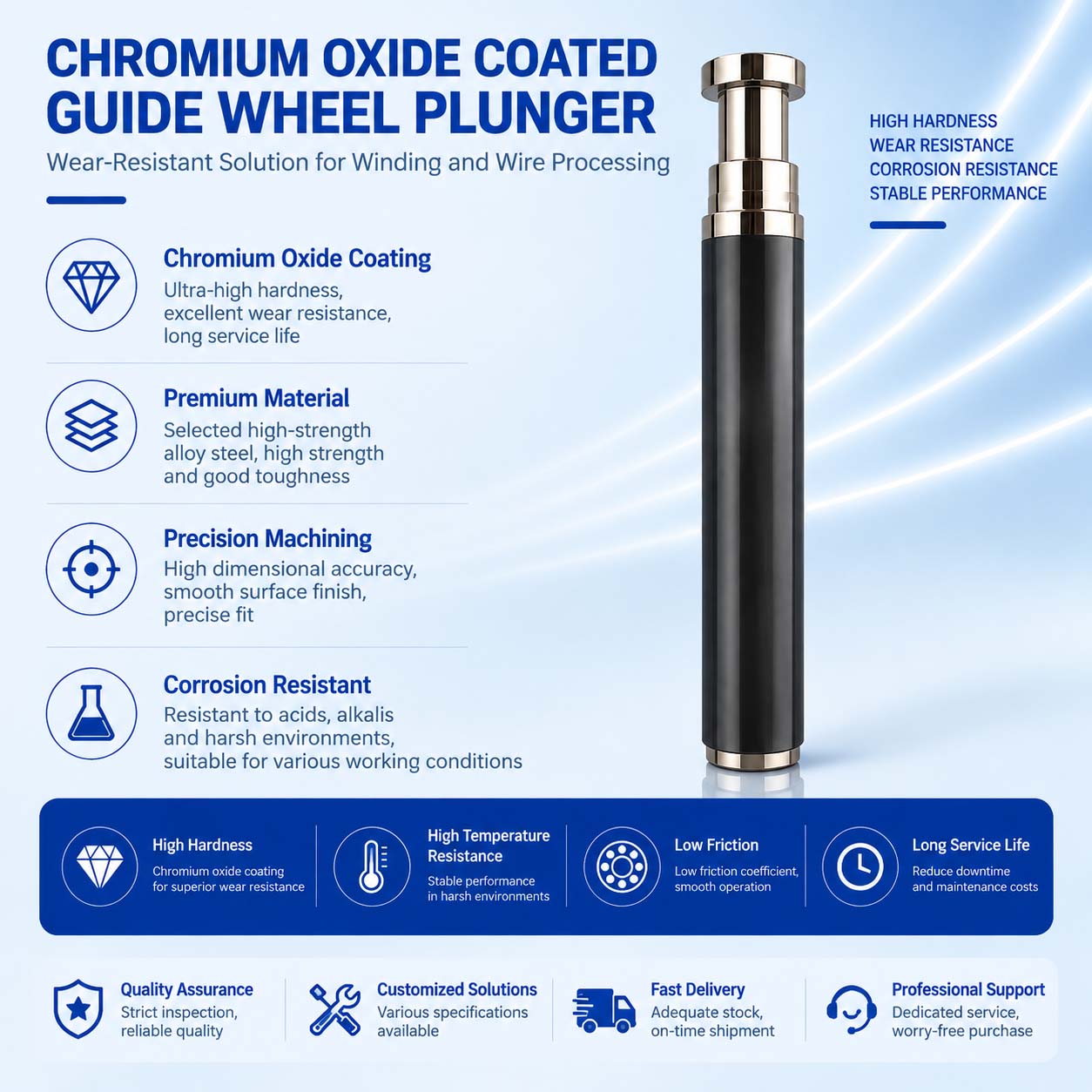
In wire and cable manufacturing, enamel wire production, and winding processes, guide wheels and plungers operate under continuous friction, tension changes, and harsh working conditions.
Without proper surface treatment, traditional metal components can experience rapid wear, frequent replacement, and reduced production efficiency.
Chromium oxide (Cr₂O₃) coating technology provides an effective surface protection solution with high hardness, low friction, and excellent corrosion resistance. It significantly improves component durability and operating stability.
This article introduces the material characteristics, applications, selection guidelines, and maintenance recommendations of chromium oxide coated guide wheels and plungers.
Coating Material and Specifications
These guide wheels and plungers use chromium oxide (Cr₂O₃) as the coating material. Through thermal spray technology, a dense protective ceramic layer is formed on the substrate surface.
Typical specifications:
- Coating material: Chromium oxide (Cr₂O₃)
- Coating thickness: 0.2–0.3 mm
Main advantages of chromium oxide coating include:
- High hardness: Effectively resists wire friction and particle abrasion.
- Excellent chemical stability: Resistant to acids, alkalis, lubricants, and cooling media.
- Smooth surface finish: Reduces wire scratches and lowers running resistance.
With proper surface preparation and spraying parameters, the coating achieves strong bonding with the substrate and provides long-term wear protection.
Typical Applications
Enameling Machine Guide Wheels
During enamel wire coating and baking processes, guide wheels are exposed to high temperatures and chemical environments.
Chromium oxide coated guide wheels provide:
- Excellent wear resistance
- Stable guiding accuracy
- Reduced enamel wire surface damage
- Longer maintenance intervals
Winding Machine Guide Wheels
During high-speed winding operations, guide wheels experience continuous friction and frequent direction changes.
Chromium oxide coatings reduce friction, minimize wire vibration, and improve winding quality and consistency.
Pay-Off and Take-Up Machine Guide Wheels
Wire tension changes significantly during pay-off and take-up processes.
Wear-resistant chromium oxide coated wheels help maintain stable surface conditions, improve tension control, and reduce wire scratches or breakage.
Plungers
In hydraulic or pneumatic mechanisms, plungers are exposed to reciprocating friction and corrosive media.
Chromium oxide coated plungers improve:
- Surface hardness
- Seal service life
- Wear resistance
- Leakage prevention
They are commonly used in tension adjustment and pressing mechanisms of wire processing equipment.
Selection and Installation Guidelines
When selecting chromium oxide coated guide wheels or plungers, consider:
Substrate Material
Select suitable metal substrates according to load, speed, and operating environment to ensure good coating adhesion.
Dimensional Accuracy
Confirm shaft diameter, wheel diameter, mounting holes, and other dimensions to ensure compatibility with the equipment.
Coating Quality
The coating surface should be free from:
- Cracks
- Peeling
- Visible defects
- Excessive pores
Installation Alignment
Ensure the guide wheel axis is perpendicular to the wire running direction to prevent uneven wear.
Lubrication Conditions
Although chromium oxide coatings can provide excellent wear resistance, proper lubrication can further extend service life in certain applications.
Maintenance Recommendations
To maximize component performance:
- Regularly inspect coating wear and replace components if the substrate becomes exposed.
- Clean surfaces with soft cloths or brushes and avoid hard tools.
- Protect components from impact during storage and handling.
- Remove corrosive residues after operation and keep components dry.
Frequently Asked Questions
Which wires are suitable for chromium oxide coated guide wheels?
They are suitable for:
- Copper wire
- Aluminum wire
- Alloy wire
- Enamel wire
The smooth surface helps prevent scratches and contamination.
Why is the coating thickness 0.2–0.3 mm?
This thickness range provides a good balance between wear resistance and coating adhesion.
Excessive thickness may increase internal stress and reduce bonding strength, while insufficient thickness may shorten service life.
Can coated guide wheels be repaired?
In some cases, old coatings can be removed and recoated. The substrate condition should be evaluated before repair.
Does plunger coating affect seal life?
A smooth chromium oxide surface reduces friction against sealing components and can help extend seal service life when properly applied.
How can coating failure be identified?
Replacement should be considered when:
- The substrate becomes exposed
- Coating peeling occurs
- Abnormal wear appears
- Wire surface scratches increase
What is the operating temperature range of chromium oxide coated wheels?
Chromium oxide coatings can withstand elevated temperatures. The exact temperature range depends on the substrate material and operating conditions, and should be evaluated according to the specific application.
Customized Chromium Oxide Coating Solutions
We provide customized chromium oxide coated guide wheels and plungers for enameling machines, winding machines, pay-off/take-up systems, and other industrial wire processing equipment.
Through advanced thermal spray technology and precision machining, our coated components deliver excellent wear resistance, stable operation, and extended service life in demanding industrial environments.
