

Coating Service Overview
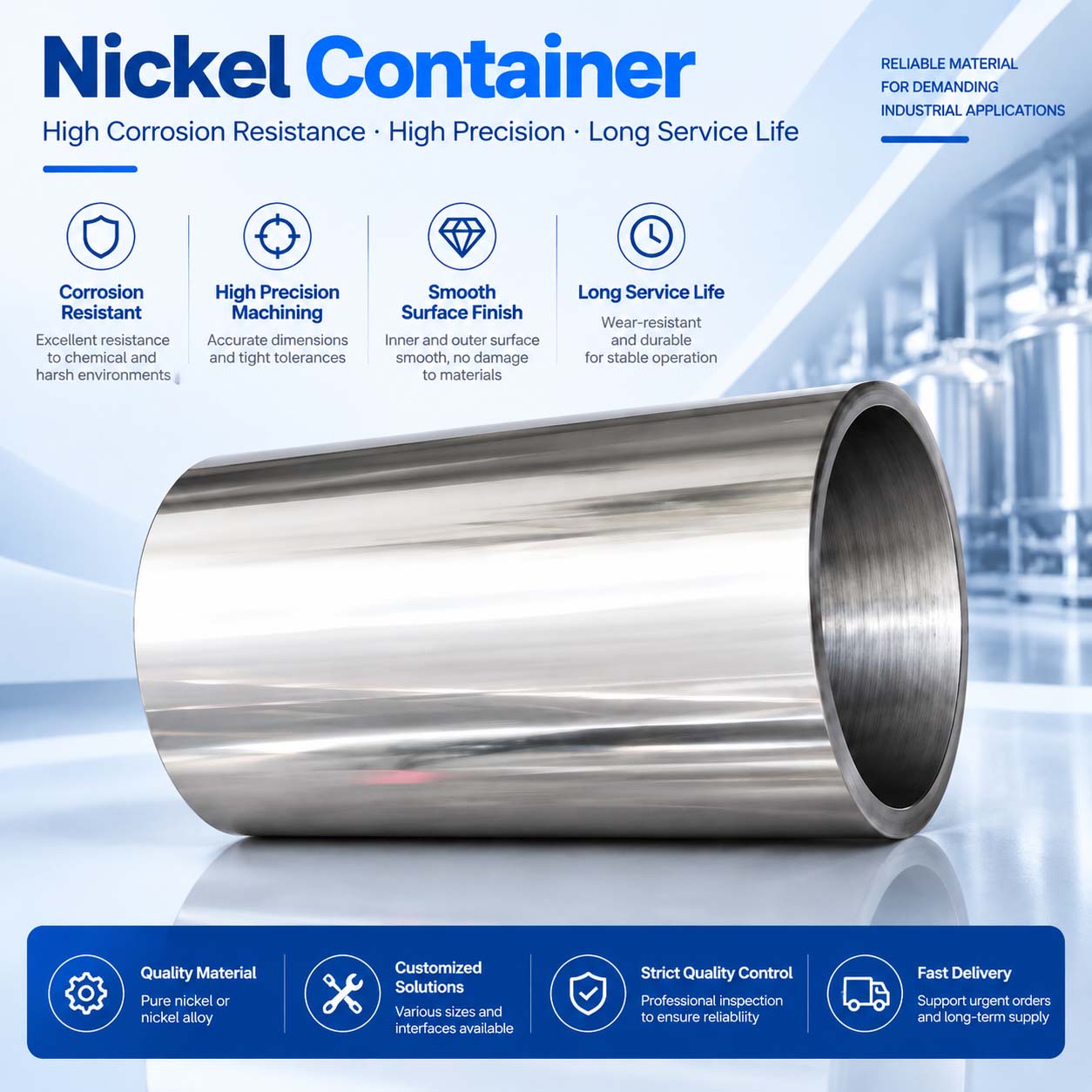
In annealing equipment and high-temperature, high-wear industrial environments, custom cemented carbide parts and nickel containers are critical components for maintaining stable production performance.
Through precision machining technology, we provide customized non-standard components made from tungsten carbide, cemented carbide, and nickel alloys to meet complex shapes, extreme wear conditions, and demanding performance requirements.
Product Types and Features
Custom Cemented Carbide Parts
Custom cemented carbide parts are manufactured using materials such as tungsten carbide and hard alloy through powder metallurgy and precision grinding processes.
They can be produced into complex-shaped wear-resistant components, including:
- Special-shaped nozzles
- Guide blocks
- Sealing rings
- Wear-resistant inserts
- Precision machine parts
Main advantages:
- Extremely high hardness
- Excellent wear resistance
- High compressive strength
- Stable performance under high-temperature conditions
These components are widely used in annealing furnaces, wire drawing machines, and other industrial equipment requiring high wear resistance.
Nickel Containers
Nickel containers are manufactured from pure nickel or nickel alloys and provide excellent:
- Corrosion resistance
- High-temperature resistance
- Chemical stability
They are commonly used in annealing processes as protective atmosphere containers, material carriers, or special media handling components.
Customized options include:
- Wall thickness
- Dimensions
- Connection structures
- Surface treatment requirements
Typical Applications
Annealing Equipment
Cemented carbide shaped parts are used for:
- Furnace supports
- Guide components
- Wear-resistant liners
Nickel containers are used as protective atmosphere vessels or workpiece carriers in high-temperature processes.
Wire Drawing and Wire Processing
Tungsten carbide components are widely applied in:
- Wire guide wheels
- Drawing machine guides
- Wear-resistant transmission parts
They help reduce wire scratches, improve dimensional stability, and extend component service life.
Surface Treatment Equipment
Tungsten carbide parts can be used in:
- Ceramic spraying equipment
- Thermal spray rollers
- Wear-resistant shaft components
They provide excellent resistance against friction, heat, and chemical environments.
Selection and Customization Guidelines
Since most products are non-standard components, the following information should be considered:
Material Selection
Choose suitable materials according to:
- Wear resistance requirements
- Temperature conditions
- Corrosion environment
- Impact loads
Common materials include:
- Tungsten carbide
- Cemented carbide
- Nickel alloys
Dimensions and Tolerances
Customers should provide:
- Technical drawings
- Samples
- Critical dimensions
- Tolerance requirements
Precision machining ensures accurate fitting and reliable performance.
Working Environment
The design should consider:
- Operating temperature
- Contact medium
- Mechanical stress
- Working frequency
Surface Treatment
Additional processes such as:
- Polishing
- Coating
- Surface finishing
can be provided according to application requirements.
We support customized manufacturing based on drawings or samples, including single-piece and small-batch production.
Installation and Maintenance Recommendations
Installation
Cemented carbide components have high hardness but are relatively brittle.
During installation:
- Avoid direct impact or hammering.
- Use proper fitting methods such as thermal fitting or press fitting.
Cleaning
For nickel containers:
- Remove residues after use.
- Prevent localized corrosion caused by accumulated materials.
Inspection
Regularly check:
- Wear condition
- Edge chipping
- Cracks
- Surface damage
Replace damaged parts promptly to prevent secondary equipment damage.
Storage
Store cemented carbide components in dry environments and avoid contact with corrosive substances.
Nickel containers should be protected from scratches that may damage the surface protection layer.
Frequently Asked Questions
How complex can cemented carbide shaped parts be?
Through powder metallurgy forming combined with precision grinding and EDM machining, components with:
- Steps
- Holes
- Grooves
- Curved surfaces
can be manufactured.
Final feasibility depends on drawing requirements and production evaluation.
What is the maximum operating temperature of nickel containers?
Pure nickel containers are generally suitable for temperatures up to approximately 1000°C in oxidizing environments.
Higher temperatures may be possible in reducing or inert atmospheres, depending on actual conditions.
What is the difference between tungsten carbide and cemented carbide?
Tungsten carbide is the main hard phase in cemented carbide materials, usually combined with cobalt as a binder.
Cemented carbide provides:
- Higher hardness
- Better wear resistance
Other tungsten-containing steels may provide better toughness.
Material selection should balance wear resistance and impact resistance.
What is the minimum order quantity?
Single-piece customization is available. There is no strict minimum order quantity, although small batches may have higher unit costs.
What is the production lead time?
Lead time depends on complexity and quantity.
Typical ranges:
- Simple parts: 7–15 working days
- Complex shaped parts: 20–30 working days
Are material certificates or inspection reports available?
Yes. Material composition analysis, hardness testing, and quality inspection reports can be provided according to customer requirements.
Customized Carbide and Nickel Component Solutions
We provide customized tungsten carbide parts, cemented carbide wear components, and nickel alloy containers for annealing equipment, wire processing, thermal treatment, and other demanding industrial applications.
With advanced manufacturing technology and precision machining capabilities, we deliver reliable components with excellent wear resistance, high-temperature performance, and long service life.
